
Cartier Panthère Watch Guide: Choosing the Right Size and Metal
Choosing a Panthère de Cartier is a little different from choosing a conventional watch. The case matters, but so does the bracelet. The dial matters, but so does the metal surrounding it. A change from steel to yellow gold or from a mini to a medium model can transform the same basic design from a delicate piece of jewellery into a much more noticeable watch.
That is part of the Panthère’s appeal. Its square case, Roman numerals, blued-steel sword-shaped hands on many references, and fluid bracelet create a design that is unmistakably Cartier without feeling like a traditional sports or tool watch. Cartier itself describes the Panthère as both a watch and a piece of jewellery.
This Cartier Panthère watch guide will help you answer three key questions: how much wrist presence do you want, which metals do you normally wear, and do you want the Panthère to behave primarily as a watch or as jewellery that also tells the time?
What Makes the Cartier Panthère Different?
The bracelet is arguably the defining feature of the Panthère de Cartier.
Cartier says the watch was designed in the 1980s and takes its name from its bracelet, whose ultra-flexible construction was intended to evoke the movement of the Maison’s emblematic panther. Instead of feeling like a watch head attached to a conventional bracelet, the Panthère flows around the wrist as one continuous design.
That changes how it’s worn. Even a relatively small Panthère can have considerable visual presence because the bracelet forms part of the overall aesthetic.
The collection also sits comfortably within Cartier’s wider jewellery heritage. The panther has appeared in Cartier’s creative vocabulary since 1914, long before the Panthère watch itself arrived. Buyers exploring Cartier watches will therefore find that the Panthère occupies a particularly jewellery-focused position within the brand’s watch collections.
Most contemporary Panthère models use quartz movements. That choice complements the collection rather than detracting from it: it allows Cartier to maintain the slim proportions that make the design work so well as jewellery.
Cartier Panthère Sizes Explained
Cartier currently makes the Panthère in four sizes: mini, small, medium, and large.
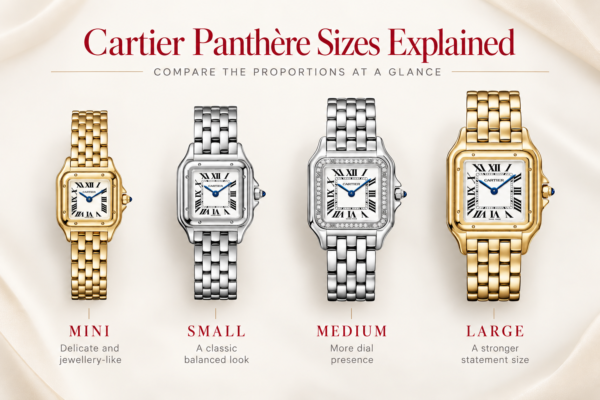
Mini Panthère
The Mini Panthère is the most delicate option and comes closest to feeling like a bracelet that also tells the time.
This yellow-gold version measures 25 x 19 mm and is just 6 mm thick. It features a quartz movement, an 18K yellow-gold case and bracelet, a silver dial, blued-steel sword-shaped hands, and an octagonal yellow-gold crown set with a sapphire cabochon.
Its compact proportions already make it highly jewellery-like, while the full yellow-gold construction gives it even more visual warmth and presence than a steel version.
The main consideration is readability. If you check the time frequently at a glance, trying the Mini on first can help you decide whether the smaller dial feels practical enough for everyday wear.
Small Panthère
The Small Panthère keeps the jewellery-like character of the Mini but gives the dial a little more presence.
This steel Panthère de Cartier watch measures 23 x 30 mm and is 6 mm thick. It combines a quartz movement with a steel case and bracelet, a silvered dial, blued-steel sword-shaped hands, and a crown set with a blue synthetic spinel.
Although compact compared with many modern watches, the Small should not be judged using the same rules as a round sports watch. Its square case and fluid bracelet work together as one design, giving it more visual presence than the dimensions alone suggest.
Choose the Small if you want the Panthère to still feel distinctly like jewellery while giving the dial slightly more prominence than the Mini.
Medium Panthère
The Medium Panthère shifts the balance a little further toward the watch itself without losing the collection’s slim, elegant character.
This version measures 36.5 x 26.7 mm and is 6 mm thick. It combines a steel case and bracelet with a bezel set with 44 brilliant-cut diamonds totaling 0.28 carats, giving the larger proportions a more jewellery-focused finish.
The medium can work especially well if you want the dial to stand out more clearly or prefer a watch that remains noticeable when worn beside bracelets.
It is also a good reminder that size is not the only factor affecting wrist presence. Diamonds, metal colour, bracelet width, and wrist shape can all change how large or small a Panthère appears once it is actually being worn.
Large Panthère
The Large Panthère gives the collection its strongest watch-first presence.
This yellow-gold version measures 31 x 42 mm and is 6.71 mm thick. It features an 18K yellow-gold case and bracelet, quartz movement, silvered dial, blued-steel sword-shaped hands, and a crown set with a blue sapphire.
The larger case makes the dial much more prominent, while the full yellow-gold bracelet gives the watch considerable visual impact.
This size can suit buyers who want the Panthère to function as a statement watch rather than disappear into a jewellery stack.
Cartier has produced different Panthère sizes and configurations over time, so always compare the exact case dimensions, metal, bracelet, and production period rather than assuming every Mini, Small, Medium, or Large model will wear exactly the same way.
How to Choose the Right Cartier Panthère Size
Forget rigid wrist-measurement charts. Start with proportion: how much of your wrist’s width does the case cover? Then ask what role you want the watch to play. Do you want a jewellery accent, a balanced everyday watch or a statement piece?
A few practical tests help:
- Wear it with your usual jewellery. If you normally stack bangles on that wrist, try the watch with them. Leave enough room that nearby pieces don’t press constantly against the case or crown.
- Check the bracelet fit. It should feel fluid and comfortable, without sliding excessively or pinching.
- Compare in person. A couple of millimetres looks surprisingly big on a wrist. Trying the mini, small, and medium side by side is the most reliable way to decide.
Cartier Panthère Metals Explained
Once you have narrowed down the size, the next step in this Cartier Panthère watch guide is choosing the metal, which can affect not only price but also how dressy, jewellery-like, or understated the watch appears.
Stainless Steel
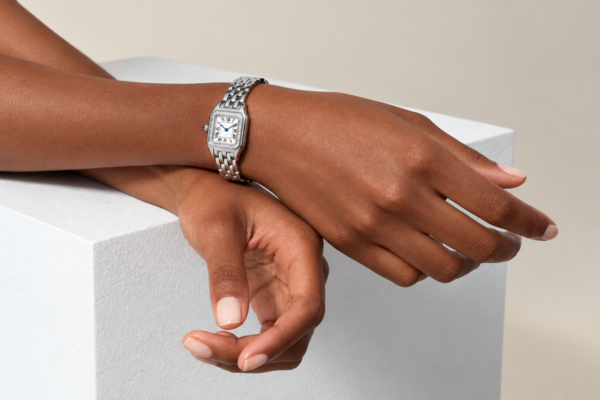
Steel is the most understated and versatile option. Its cooler tone pairs easily with white gold, platinum, and silver jewellery, while keeping the Panthère feeling lighter and less jewellery-heavy than a full-gold version.
For example, Berani’s steel Small Panthère with diamonds combines a steel case and bracelet with a diamond-set bezel, giving the watch extra sparkle without losing the clean, cool-toned look of steel.
Steel is still subject to wear, though. Fine scratches and bracelet marks can develop with regular use, so it should not be treated as maintenance-free.
Yellow Gold
Yellow gold is the warmest and most jewellery-forward option. On the Panthère’s articulated bracelet, solid gold makes the watch feel especially close to a fine bracelet.
For example, Berani’s yellow-gold Panthère combines an 18K yellow-gold case and bracelet with the collection’s signature square dial and blue details.
Gold is softer than steel and can show surface marks more readily, making it best suited to buyers who already wear yellow gold or want the Panthère to make more of a statement.
Rose Gold
Rose gold is warm like yellow gold but softer and a little more contemporary. It pairs naturally with rose-gold jewellery and works well in mixed-metal stacks.
For example, Berani’srose-gold Mini Panthère combines 18K rose gold with diamond setting across the case and bracelet, creating a much more jewellery-forward look.
Cartier also offers plainer rose-gold configurations, and the same surface-wear considerations apply as with yellow gold because gold is softer than steel.
White Gold
White gold gives the Panthère the cool-toned look of steel with the richer feel of a precious metal. It is a natural fit if most of your jewellery is silver-toned, white gold, or platinum.
For example, Berani’s white-gold Mini Panthère combines a rhodiumized white-gold case and bracelet with brilliant-cut diamonds, giving the compact Mini size a much more luxurious, jewellery-forward finish.
Like other gold versions, white gold is softer than steel and can show surface wear over time, especially on polished areas.
Two-Tone Steel and Gold
Two-tone Panthère models bridge the cooler look of steel with the warmth of gold, making them especially easy to pair with a mixed-metal jewellery wardrobe.
For example, Berani’s two-tone Large Panthère combines 18K yellow gold and steel across the case and bracelet, giving the larger size a more balanced look than either full steel or full gold.
Because the amount and placement of gold can vary by model, it is worth comparing two-tone versions beside full-steel and full-gold Panthères to see which balance suits your style best.
Diamond-Set Panthère Watches
Diamonds push the Panthère even further into fine-jewellery territory. Some versions use relatively subtle accents, while others are set much more extensively across the case and bracelet.
For example, Berani’s diamond-set yellow-gold Medium Panthère combines an 18K yellow-gold case set with 44 brilliant-cut diamonds with a bracelet semi-set with 142 additional diamonds, creating a much more statement-focused look.
Metal size and diamond placement all affect the overall impact, so think about whether you want noticeable sparkle from across the room or a more restrained jewellery detail.
Quartz Movement and Everyday Ownership
The Panthère is built around quartz, the right choice for a slim, jewellery-led design. A thin quartz movement keeps the case refined, and it shouldn’t be read as lower quality or a sign of anything less than authentic. If you’re curious how quartz compares with automatic and manual-wind calibers, here’s a guide to different watch movement types.
Ownership is simple but not zero-maintenance. The battery needs replacing, and the watch benefits from periodic professional inspection. If you’re buying a vintage or pre-owned example, confirm the movement for that exact reference. Don’t use movement type alone to judge authenticity.
Buying a New vs. Pre-Owned Cartier Panthère
The pre-owned market can be particularly interesting for the Panthère because it opens the door to previous references, sizes, and configurations that may differ from the current collection.
As with the current models covered in this Cartier Panthère watch guide, careful comparison is especially important when considering a pre-owned watch.
When buying a pre-owned luxury watch in Canada, look beyond whether the watch appears attractive in photographs. Confirm the reference, dimensions, metal, movement, and bracelet configuration. Examine the clasp, crystal, dial, crown, case finishing, link condition, and available service history.
Be cautious about excessive refinishing as well. Cartier notes that polishing removes a thin layer of material and recommends no more than three polishings during the life of a watch.
Boxes, warranty cards, receipts, and service records can add useful provenance, but paperwork alone should not be treated as proof of authenticity.
What to Check Before Choosing Your Cartier Panthère
Before choosing, compare the exact watches, not just the collection name.
Pay attention to:
- Reference number
- Case size and proportions
- Metal and diamond configuration
- Bracelet condition and fit
- Movement
- Service history
- Box, papers, and other documentation
For bracelet models, also check whether there are enough links for a comfortable fit. Cartier bracelets can often be adjusted by adding or removing links, depending on the reference.
Most importantly, use this Cartier Panthère watch guide as a starting point and try different versions on if you can. A small steel Panthère and a medium yellow-gold Panthère may belong to the same collection, but they can look and feel completely different on the wrist.
Berani offers authentic Cartier watches that can be compared in person, making it easier to judge size, metal, proportion, and overall wrist presence before choosing the right Panthère.
Frequently Asked Questions
1. Is the Cartier Panthère too small for everyday wear?
Not necessarily. The Panthère is intentionally more jewellery-oriented than many conventional watches. Buyers who enjoy delicate proportions may prefer the mini or small, while those who prioritize a larger, easier-to-read dial may prefer the medium or large.
2. Can a Cartier Panthère bracelet be resized?
Yes, many metal Panthère bracelets can be adjusted by adding or removing links. Cartier offers professional bracelet adjustment for its metal watches. The exact adjustment available depends on the reference and bracelet, so professional sizing is preferable to attempting to remove links yourself.
3. Does a Cartier Panthère bracelet stretch over time?
Wear can develop in a metal bracelet with age and regular use. On a pre-owned watch, inspect how the links articulate, how securely the clasp operates, and how the bracelet sits rather than assuming significant looseness is simply normal.
4. Is a gold Cartier Panthère more delicate than a steel one?
Gold is softer than steel and generally shows scratches and surface marks more readily. Both can be worn regularly, but how a watch ages depends heavily on how it is worn, stored, stacked with other jewellery, and maintained.
5. Can men wear the Cartier Panthère?
Yes. Although Cartier has traditionally marketed many Panthère references as women’s watches, there is no functional reason the design is limited by gender. The more useful considerations are wrist proportion, comfort, size, metal, and the style the wearer wants to achieve.