
Cartier Watch Maintenance: How to Care for and Service Your Timepiece
A Cartier watch is designed to be worn, but how you wear, clean, store, and service it can make a noticeable difference to its condition over time. Good Cartier watch maintenance is not about keeping a timepiece untouched. It is about protecting it from unnecessary wear while giving the movement, case, bracelet, or strap the care appropriate to the specific model.
That matters because Cartier watches are not all built the same way. A quartz Panthère has different maintenance considerations from an automatic Santos or a manual-wind Cartier watch. Leather straps, metal bracelets, precious metals, gemstones, and vintage pieces also require different approaches.
The best rule is simple: use gentle everyday care, avoid unnecessary DIY work, and follow the recommendations for your exact Cartier reference when professional attention is required.
Cartier Watch Maintenance at a Glance
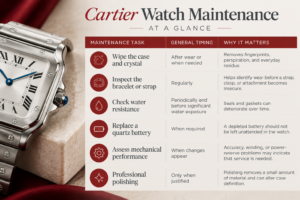
You do not need to constantly clean or service your watch. A few consistent habits can go a long way.
There is no single maintenance schedule that applies equally to every Cartier watch. Movement, materials, age, climate, frequency of wear, and exposure to water all matter.
1. Know What Kind of Cartier Watch You Own
Before cleaning, winding, or servicing a Cartier, identify the exact model and movement.
Cartier has produced quartz, automatic, and manual-wind watches, and each works differently. If you are unfamiliar with the distinctions, our guide to different watch movement types is a useful starting point.
Quartz Cartier watches
Quartz movements are found in many Cartier references, including Panthère models and certain Tank and Santos watches.
For example, Berani’s small Panthère de Cartier watch combines a quartz movement with a steel case and bracelet. Its routine ownership needs are therefore different from those of a mechanical watch.
A quartz watch does not require winding, but its battery eventually needs professional attention. If the watch stops or shows a low-battery indication where applicable, do not simply leave it in a drawer indefinitely. Have it assessed and the battery replaced appropriately.
Automatic Cartier watches
An automatic movement uses the motion of the wearer’s wrist to wind its mainspring. If an automatic Cartier has not been worn for some time, it may stop. That alone does not necessarily indicate a problem.
Our guide to automatic watches explains how these movements work and what owners should know about winding and power reserve.
Changes in accuracy, noticeably reduced power reserve, unusual noises, or abnormal winding behaviour, however, deserve professional attention.
Manual-wind Cartier watches
A manual-wind movement requires winding by hand. Follow the instructions for the exact reference and wind gently rather than forcing the crown.
If winding suddenly feels rough, slips, or develops unusual resistance, stop rather than trying to force the mechanism.
2. Build a Few Good Daily Habits
Most Cartier care happens between professional services.
Put your watch on after perfume, lotion, sunscreen, and other cosmetics have dried. This reduces direct contact between the watch and substances that can accumulate on its surfaces or strap.
After wearing it, particularly on a warm day, gently wipe the case and bracelet with a clean, soft, lint-free cloth to remove perspiration and fingerprints.
It is also sensible to remove a luxury watch before activities involving strong impacts, vibration, chemicals, or abrasive surfaces.
The right approach depends partly on the watch itself. The exposed surfaces of a Santos de Cartier, for example, have a very different design from the flexible, jewellery-like bracelet of a Panthère or the leather strap commonly associated with many Tank configurations.
For general habits that apply beyond Cartier, see our guide on how to take care of a luxury watch.
3. How to Clean a Cartier Watch Safely
Cleaning is one area where doing less, but doing it correctly, is usually preferable to aggressive DIY methods.
Cleaning the Case and Crystal
For routine cleaning, start with a clean, soft, lint-free cloth.
Avoid attempting to remove scratches with toothpaste, abrasive polishing compounds, jewellery dips, household cleaners, alcohol, solvents, or abrasive pads. A product that appears harmless on one material may damage another surface, finish, coating, gemstone, or strap.
For more substantial cleaning, the correct method depends on the watch’s materials and water-resistance condition.
Cleaning a Metal Cartier Bracelet
Bracelet links naturally collect dust, perspiration, and residue through regular wear.
A soft cloth can handle basic surface cleaning. A lightly dampened cloth may be suitable in some circumstances, but only when moisture exposure is appropriate for that particular watch and its water resistance is in good condition.
Do not assume that because the bracelet is metal, the entire watch can be soaked.
This deserves particular attention with the Panthère because its flexible bracelet is a defining element of the design. Keeping the spaces between links free of excessive buildup helps maintain its appearance without resorting to aggressive cleaning.
Caring for a Cartier Leather Strap
Leather requires a different approach.
Try to limit exposure to:
- Water and high humidity
- Perfume and cosmetics
- Oils and chemicals
- Prolonged direct sunlight
Leather is a wear component and will naturally change with use. Cracking, significant stretching, persistent odour, loose stitching, or an insecure attachment can indicate that replacement should be considered.
4. Water Resistance is Not Permanent
One of the most important Cartier maintenance principles is also one of the easiest to overlook: water resistance can change over time.
A watch’s stated water-resistance rating relates to specific test conditions. Its protection may be affected by ageing gaskets, impacts, damage to the crown, or previous opening of the case.
For that reason, never assume an older Cartier still offers the same protection it did when new without appropriate checks.
You should also avoid:
- Operating the crown underwater
- Using pushers underwater unless the exact model instructions specifically permit it
- Assuming every Cartier model is suitable for swimming
- Treating “water resistant” as meaning “waterproof”
If you intend to expose your watch regularly to water, check the specifications and current instructions for the exact reference and consider having its water resistance professionally tested.
5. Protect Your Cartier From Shock, Magnetism, and Extreme Temperatures
A luxury watch can be built for everyday wear without being immune to its environment.
Impact and Vibration
A hard impact can affect more than the appearance of the case. It can potentially damage the movement, crystal, crown, bracelet, clasp, or strap attachments.
If your Cartier receives a significant impact and subsequently behaves differently, professional inspection is safer than trying to diagnose it yourself.
Magnetism
Strong magnetic fields can affect the performance of some mechanical watches. Everyday environments contain many magnetic sources, but the sensible approach is simply to avoid placing a mechanical watch directly beside strong magnets.
A sudden change in accuracy after magnetic exposure should be assessed professionally rather than corrected through DIY demagnetizing.
Temperature
Extreme heat, extreme cold, and sudden temperature changes can affect a watch and its seals, lubricants, or other components. Saunas and similar high-temperature environments are best avoided unless the manufacturer’s guidance for the exact watch indicates otherwise.
6. How Often Should a Cartier Watch Be Serviced?
There is no responsible universal answer such as “every X years” for every Cartier ever made.
The appropriate timing depends on factors including:
- The movement
- Model and reference
- Age
- Condition
- Frequency of wear
- Environment
- Previous service history
- Current Cartier recommendations
Instead of relying only on the calendar, pay attention to the watch.
A mechanical Cartier may deserve assessment if it suddenly gains or loses substantially more time than usual, develops a reduced power reserve, makes unusual noises, or becomes difficult to wind.
Visible condensation is more urgent. Moisture beneath the crystal should be treated as a reason to stop exposing the watch to water and arrange professional assessment promptly.
For quartz watches, a stopped movement or low-battery indication where applicable should also be addressed rather than ignored.
7. What Happens During a Professional Cartier Watch Service?
A professional service is much more involved than wiping the case and replacing a strap.
Depending on the watch’s movement, age, condition, and the work authorized, servicing may include:
- Diagnosis and inspection
- Opening and examining the case and movement
- Cleaning movement components
- Lubrication
- Replacement of worn components where required
- Battery replacement for quartz watches
- Gasket work
- Timing and functional testing
- Water-resistance testing
- Exterior refinishing when requested and appropriate
Not every Cartier needs every procedure at every service. The scope, replacement parts, refinishing, estimate, timing, and warranty should be discussed with the service provider before work begins.
This is also why opening a Cartier at home is generally a poor maintenance shortcut. Improper tools or handling can damage the case, seals, movement, or water resistance.

8. Should You Polish a Cartier Watch?
A scratched Cartier can make polishing tempting, but polishing deserves more consideration than ordinary cleaning.
Professional polishing removes a very small amount of metal to reduce visible surface marks and restore a more uniform finish. Repeated or excessive polishing, however, can gradually soften edges and change original case geometry.
That can be especially important with:
- Vintage Cartier watches
- Collectable references
- Frequently polished watches
- Cases with sharply defined edges
- Watches with multiple contrasting finishes
If preserving original case definition matters to you, discuss your priorities before authorizing refinishing.
And remember: servicing does not automatically mean polishing. You can discuss movement maintenance separately from cosmetic refinishing.
9. How to Store a Cartier Watch
A watch does not need an elaborate storage system, but it does need protection.
Choose a clean, dry, temperature-stable location away from:
- Direct sunlight
- Strong magnets
- Chemicals
- Excessive humidity
- Hard jewellery that can scratch the case or crystal
A suitable watch box, soft pouch, or separated jewellery compartment can protect the watch when it is not being worn.
Close clasps carefully and avoid forcing components into a position they do not naturally take.
For long-term storage, follow the guidance appropriate to the movement. An automatic watch winder is not a requirement for every automatic watch or every owner.
10. Cartier Watch Maintenance Mistakes to Avoid
Some of the most damaging maintenance habits come from trying too hard to keep a watch looking new.
Avoid:
- Cleaning with toothpaste or abrasive products
- Using jewellery dips or harsh household chemicals
- Assuming water resistance lasts forever
- Operating the crown or pushers underwater
- Opening the case without appropriate expertise
- Attempting an unqualified battery replacement
- Forcing the crown, clasp, screws, or winding mechanism
- Ignoring condensation or sudden performance changes
- Repeatedly polishing without considering the case’s original shape
- Applying maintenance advice from one Cartier reference to every other model
When in doubt, less intervention is usually safer than an improvised repair.
11. Signs Your Cartier Watch Needs Professional Attention
Some issues should not wait for routine maintenance.
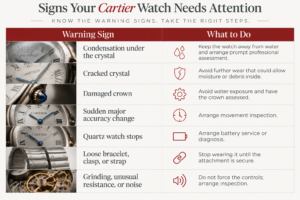
The purpose is not to assume the worst. It is to prevent a relatively small issue from becoming a more complicated repair.
12. Protect the History of Your Cartier, Too
Maintenance records are part of caring for a luxury watch.
Keep:
- Original purchase documents
- Warranty information
- Service invoices
- Completed-work records
- Details of replaced components
- Clear photographs of the watch
These records can be useful for future servicing and may also support insurance or resale discussions.
If you own a particularly valuable timepiece, our guide to watch insurance in Canada explains coverage considerations and the role of documentation.
Caring for a Cartier is About Consistency, Not Perfection
A Cartier watch does not have to remain completely scratch-free to be well cared for. Watches are made to be worn, and signs of normal use are part of ownership.
Good Cartier watch maintenance is instead about avoiding preventable damage, cleaning gently, understanding the needs of your movement, and responding when the watch shows signs that professional attention may be necessary.
Whether your preference is the jewellery-like Panthère, the architectural Santos, or the classic Tank, learning how your particular Cartier works is the best place to start.
If you are still deciding which collection suits you, explore our Cartier watch buying guide or shop Cartier watches available through Berani Jewellers.
FAQs
How often should a Cartier watch be serviced?
There is no single service interval appropriate for every Cartier watch. Timing depends on the movement, reference, age, condition, use, and current manufacturer recommendations. Have the watch assessed sooner if you notice unusual accuracy changes, reduced power reserve, moisture, winding problems, or other changes in operation.
How should I clean my Cartier watch at home?
For routine cleaning, gently wipe the case and crystal with a clean, soft, lint-free cloth. Avoid toothpaste, abrasive pads, jewellery dips, solvents, and household cleaning products. Deeper cleaning should account for the watch’s materials, strap or bracelet, gemstones, and current water-resistance condition.
Can I wear my Cartier watch in water?
It depends on the exact reference and its current condition. Water resistance varies between Cartier watches and can decline as seals age or after impacts or servicing. Check the specifications for your model and have its water resistance assessed before relying on it for swimming or frequent water exposure.
How long does a Cartier watch battery last?
Battery life varies depending on the specific quartz movement, watch functions, age, and operating conditions, so there is no single lifespan applicable to every Cartier watch. If a quartz Cartier stops or displays a low-battery indication where applicable, arrange professional battery service rather than leaving a depleted battery inside indefinitely.
Should I polish my Cartier watch?
Not automatically. Polishing can reduce visible scratches, but it also removes a small amount of metal and can gradually alter the original lines of the case. This is particularly important with vintage, collectible, or previously polished watches. Discuss the desired cosmetic result before authorizing refinishing.
What are the signs that my Cartier watch needs service?
Warning signs can include unexpected accuracy changes, reduced power reserve, unusual sounds, difficult winding, a damaged crown, condensation beneath the crystal, or a quartz watch that stops. A loose clasp, bracelet, or strap attachment also deserves immediate attention before the watch is worn again.
How should I store a Cartier watch when I am not wearing it?
Keep it in a clean, dry, temperature-stable place away from direct sunlight, strong magnets, chemicals, and other jewellery that could scratch it. A watch box, soft pouch, or separate lined compartment can provide suitable protection. Long-term storage considerations may differ depending on the movement.