
Hesalite vs. Sapphire Omega Speedmaster: Which Moonwatch Crystal Is Better for You?
Choosing between a Hesalite and sapphire Omega Speedmaster Moonwatch comes down to more than scratch resistance. Hesalite offers the traditional Moonwatch appearance and a closer connection to its spaceflight history, while sapphire provides greater resistance to everyday scratches and a transparent caseback. Both are appealing choices, but the right one depends on how you wear your watch, what you appreciate visually, and how much you want to spend.
Hesalite vs. Sapphire Speedmaster: A Quick Moonwatch Comparison
The Omega Speedmaster Moonwatch Professional comes in both Hesalite and sapphire versions. At first glance, they look almost identical, but the crystal material affects their appearance, scratch resistance, maintenance, and price. Here’s how they compare.
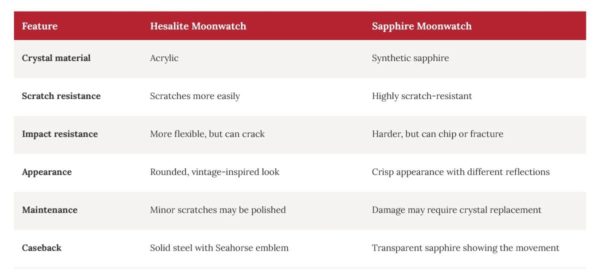
Both versions share the Moonwatch’s iconic 42 mm stainless steel case, black dial, and manual-winding mechanical movement. The biggest differences are how the crystals look, how they handle everyday wear, and whether you can see the movement through the back of the watch.
What Hesalite Is and Why It Matters to the Moonwatch
Hesalite is Omega’s name for its acrylic watch crystal. Unlike traditional glass or sapphire, acrylic is a lightweight, flexible, plastic-based material. It may scratch more easily, but it has something that many watch enthusiasts appreciate: a direct connection to the Moonwatch’s history.
The Omega Speedmaster was introduced in 1957 as a chronograph designed for precise timing, particularly in motorsport. In 1965, NASA qualified the Speedmaster for crewed space missions, and the watch became part of history when astronauts wore it during the Apollo programme, including the first Moon landing in 1969.
The Speedmasters used during these missions featured Hesalite crystals. Acrylic was particularly suitable for spaceflight because it was less likely than brittle glass to shatter into sharp fragments if damaged.
Today’s Hesalite Omega Speedmaster Moonwatch continues this tradition with its rounded crystal, classic black dial, and solid steel caseback. These features give it an appearance that closely resembles the watches worn by Apollo astronauts. For collectors who value the Moonwatch’s history, Hesalite isn’t simply a crystal choice. It’s part of what makes the watch special.
What Sapphire Changes
Sapphire brings a more modern approach to the Omega Speedmaster Moonwatch. Made from synthetic sapphire crystal, it is exceptionally hard, ranking 9 on the Mohs hardness scale. This makes it far more resistant to everyday scratches than Hesalite. The sapphire Moonwatch also features an anti-reflective coating on the inside of its crystal, helping improve dial visibility under different lighting conditions. However, reflections can still appear depending on the angle and lighting.
Another major difference is the transparent caseback. Unlike the Hesalite version, which has a solid steel back, the sapphire Moonwatch lets you see its mechanical movement in action. Through the transparent caseback, you can admire the Omega Co-Axial Master Chronometer calibre 3861, including its intricate components and decorative finishing. This design is often called the “sapphire sandwich” because sapphire crystals cover both the front and back of the watch.
If you’re curious about the technology inside the watch, Berani’s guide to the Omega Co-Axial escapement explains how this mechanism works. For buyers who appreciate modern materials, scratch resistance, and the craftsmanship of mechanical movements, the sapphire Moonwatch offers an appealing combination of practicality and design.
Scratch Resistance Is Not the Same as Impact Resistance
One of the biggest misconceptions in the Hesalite versus sapphire debate is that the harder material must always be more durable. The reality is more complicated.
- Hesalite is softer, meaning ordinary contact with hard surfaces can leave visible scratches. A sleeve button, desk edge, or accidental scrape may affect its appearance.
- Sapphire handles many of these everyday contacts better because of its greater surface hardness.
However, scratch resistance and impact resistance measure different properties. A hard impact can chip or fracture sapphire. Hesalite has greater flexibility, but it can still crack, deform, or suffer damage. Neither crystal should be considered unbreakable, and neither protects the entire watch from damage during a fall.
Consider how you normally use your watches. If you frequently encounter situations where the crystal might rub against hard surfaces, sapphire may offer greater peace of mind.
If your main concern is maintaining the traditional Moonwatch appearance, Hesalite may remain appealing despite its greater susceptibility to scratches. Ultimately, crystal material is only one part of a watch’s overall durability.
Appearance, Dial View, and Reflections
Although both versions of the Omega Speedmaster Moonwatch share the same iconic design, their crystals create slightly different visual effects.
- Hesalite gives the Moonwatch a softer, more vintage-inspired appearance. Its rounded edges subtly distort light when viewed from certain angles, creating a distinctive look that many collectors associate with the original Moonwatch. This effect adds character to the black dial and complements the watch’s historical design.
- Sapphire offers a sharper, more contemporary appearance. Its clarity makes the dial details look crisp, particularly when viewed directly. However, sapphire can produce more noticeable reflections under certain lighting conditions. The anti-reflective coating on the modern sapphire Moonwatch helps reduce glare, although it does not eliminate reflections entirely.
The difference is easiest to appreciate when comparing both watches in person. Try looking at the dial from different angles and under natural and indoor lighting. Pay attention to how the crystal edges, hands, and hour markers appear.
Ultimately, Hesalite appeals to those who love the Moonwatch’s vintage character, while sapphire suits buyers who prefer a cleaner, more modern look. Neither is inherently better; it comes down to personal taste.
Compare the Whole Watch, Not Just the Crystal
The crystal is an important difference between the Hesalite and sapphire Omega Speedmaster Moonwatch, but it’s not the only detail worth considering. Both versions share the same iconic design, yet there are subtle differences in their appearance and finishing.
- The Hesalite Moonwatch features a 42 mm stainless steel case, a classic black dial, and a solid steel caseback decorated with Omega’s Seahorse emblem. Its predominantly brushed bracelet gives it a more understated, vintage-inspired appearance that stays close to the Moonwatch’s original design.
- The sapphire Moonwatch has the same 42 mm stainless steel case and black dial, but it features a transparent caseback that reveals the mechanical movement. It also has an applied Omega logo on the dial and a bracelet combining polished and brushed surfaces, giving it a slightly more refined appearance.
Despite these differences, both watches are powered by the Omega Co-Axial Master Chronometer calibre 3861, a manual-winding movement with approximately 50 hours of power reserve. You can learn more about the technology in Berani’s guide to the Omega Co-Axial escapement or explore how it compares with different watch movement types.
There are also minor differences in thickness. The Hesalite Moonwatch measures approximately 13.54 mm thick, while the sapphire version is slightly slimmer at 13.18 mm. Both have a 47.5 mm lug-to-lug measurement, so their overall fit on the wrist is very similar.
The key takeaway? If you prefer a traditional, understated Moonwatch, Hesalite may be the better fit. If you appreciate polished details and enjoy seeing the movement through the caseback, sapphire has an advantage. Comparing both in person can help you decide which design feels right for you.
Care, Scratches, and Crystal Replacement
Both Hesalite and Sapphire Omega Speedmaster Moonwatches require proper care, but their crystal materials have different maintenance needs.
- Hesalite is more prone to scratches, especially with regular wear. Small surface marks may be removed through professional polishing, helping restore the crystal’s appearance. However, deeper scratches, cracks, or other significant damage may require a complete crystal replacement.
- Sapphire is much more resistant to everyday scratches, making it an appealing option for frequent wear. However, it isn’t indestructible. A strong impact can chip or crack the crystal, and damaged sapphire generally needs to be replaced rather than polished.
If either crystal requires replacement, professional servicing is important. A watchmaker may also need to inspect the seals and test the watch’s water resistance to ensure everything is functioning correctly.
Both Moonwatch versions have a water-resistance rating of 50 metres (5 bar), but this does not guarantee that an older or damaged watch maintains its original protection. For long-term care, follow Omega’s official recommendations and have your Moonwatch professionally inspected if you notice crystal damage or signs of moisture inside the watch.
Which Moonwatch Makes Sense for Your Routine?
Choosing between Hesalite and sapphire depends on your lifestyle and personal preferences.
- Choose Hesalite if you love tradition. Its rounded crystal, brushed bracelet, and solid caseback reflect the classic Moonwatch design worn during the Apollo era. It’s an appealing choice for collectors who appreciate the watch’s history.
- Choose sapphire if you prefer everyday practicality. Its scratch-resistant crystal makes it suitable for frequent wear, while the transparent caseback lets you admire the mechanical movement. Polished details give it a slightly more modern appearance.
Still undecided? Explore Berani’s collection of Omega watches and compare both versions in person. The best Moonwatch is the one that suits your wrist, style, and daily routine.
What Else Should You Consider Before Choosing?
Beyond crystal material, think about how often you’ll wear your Moonwatch, how much maintenance you’re comfortable with, and which design you find more appealing.
Hesalite offers a traditional look with the possibility of professionally polishing minor scratches, while sapphire provides greater scratch resistance and a view of the movement.
Both versions share the Moonwatch’s iconic design and mechanical craftsmanship. For additional buying guidance, explore Berani’s Omega watch prices in Canada guide, which covers factors to consider when choosing an Omega watch.
Find Your Omega Speedmaster Moonwatch at Berani
Hesalite or sapphire? Both preserve the distinctive character of the Omega Speedmaster Moonwatch, but they offer different ownership experiences. Choose Hesalite if the traditional appearance and historical connection matter most. Choose sapphire if scratch resistance and a view of the movement are higher priorities.
Before deciding, compare the exact references, consider the price difference, and try both configurations whenever possible. To explore current models or discuss your preferences, visit Berani in Toronto and discover which Omega Speedmaster Moonwatch suits you best.
Frequently Asked Questions
1. Can I replace a Hesalite Moonwatch crystal with sapphire later?
A conversion should not be assumed possible simply because the watches look similar. Crystal dimensions, fitting components, seals, and case compatibility require confirmation with Omega or an authorized service provider. An aftermarket sapphire conversion would also not automatically make a Hesalite version equivalent to a factory sapphire Moonwatch.
2. What does condensation beneath a Moonwatch crystal mean?
Persistent condensation inside the crystal may indicate moisture entering the watch, regardless of whether it uses Hesalite or sapphire. Because moisture can damage mechanical components, arrange prompt professional inspection. Avoid attempting to dry the watch using household heat or other home remedies.
3. Does a service replacement crystal affect a vintage Speedmaster’s originality?
A correct service replacement can help maintain the watch’s functionality, but it is not necessarily the same as retaining its original period crystal. For vintage Speedmasters, collectors may distinguish between factory-original components and later service parts. Keep records of replacements and maintenance so the watch’s condition and history can be accurately assessed.
4. Is the Hesalite or sapphire Moonwatch better for everyday wear?
Both can be worn daily, but sapphire is generally more resistant to scratches from everyday contact. Hesalite requires more attention to surface marks, although minor scratches may be professionally polished. The better choice depends on your lifestyle and preferred appearance.
5. Do Hesalite and sapphire Moonwatches have the same movement?
Yes. The modern black-dial Moonwatch Professional models discussed here both feature the Omega Co-Axial Master Chronometer calibre 3861, a manual-winding movement with approximately 50 hours of power reserve. The main differences are in their crystals, casebacks, and finishing details.