
How to Authenticate Roberto Coin Jewellery
Authenticating Roberto Coin jewellery requires more than finding the brand’s famous hidden ruby. Although the ruby, gold hallmarks and signature engravings are useful details to examine, none can confirm authenticity on its own. The most reliable approach combines purchase history, accurate product information, craftsmanship, and professional evaluation.
If you’re considering pre-owned Roberto Coin jewellery or checking a piece you already own, this guide explains what to look for, which warning signs deserve attention, and when to seek expert assistance.
How to Authenticate Roberto Coin Jewellery: Key Things to Check
Roberto Coin jewellery is recognized for its Italian craftsmanship, distinctive designs, and hidden ruby signature. However, these recognizable characteristics can also be imitated, making authentication more complicated than checking a single detail.
Here’s what to examine before deciding whether a piece is genuine.
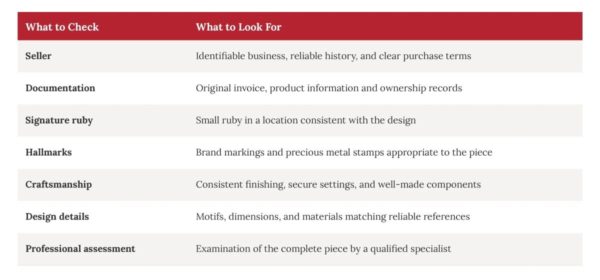
No single feature guarantees authenticity. A ruby can be added to imitation jewellery, hallmarks can be copied, and even convincing packaging may not establish where a piece originated. For a better understanding of the brand’s distinctive design features, explore Roberto Coin’s Italian design and collections.
1. Check the Seller and Purchase History
One of the most useful steps in authenticating Roberto Coin jewellery happens before you examine the jewellery itself: understanding where it came from.
A purchase from a retailer confirmed through Roberto Coin’s official network provides a clearer purchasing history than an anonymous online listing. However, if you’re buying pre-owned jewellery, the original seller may no longer be involved.
Look for the following information:
- Original receipt or invoice: Ideally, it should identify the retailer, purchase date, and jewellery description.
- Product details: A model name or reference number can help you compare the piece with official records.
- Ownership history: Previous purchase, inheritance, or resale information may explain how the jewellery changed hands.
- Return conditions: Understand what happens if the jewellery differs from its description or raises authenticity concerns.
You can also compare the item with the Roberto Coin jewellery featured at Berani to become familiar with the brand’s collections and design details.
An original receipt is helpful, but documentation alone does not prove authenticity. Paperwork can be inaccurate, transferred between pieces or falsified, so it should support a broader assessment rather than replace one.
2. Look for Roberto Coin’s Signature Ruby
One of the most recognizable features of Roberto Coin jewellery is the small ruby discreetly incorporated into many of the brand’s creations. Introduced as a brand signature in 1996, the hidden ruby represents love, good wishes and protection. Roberto Coin traditionally positions it on the inside of a piece, close to where the jewellery touches the wearer’s skin.
The exact location depends on the design. You may find it inside a ring, on the back of a pendant or in a discreet area of a bracelet or earring.
Does Every Roberto Coin Piece Have a Ruby?
The ruby is a signature feature, but not every authentic Roberto Coin creation necessarily contains one. The manufacturer acknowledges a small number of exceptions, which may be identified in the relevant product information. The ruby’s placement can also vary according to the construction of the jewellery. This means two common assumptions are unreliable:
- Finding a red gemstone does not automatically mean the jewellery is genuine.
- Failing to find a ruby does not automatically mean the jewellery is counterfeit.
If the ruby appears missing, unusually positioned, or inconsistent with the design, compare the exact reference with manufacturer information. For further context, Roberto Coin’s official Behind the Brand page explains the ruby tradition and its significance.
3. Examine the Hallmarks and Brand Engravings
Hallmarks and signatures are another important part of Roberto Coin authentication. These markings help identify the jewellery’s stated manufacturer and metal composition, although their appearance can vary.
Roberto Coin jewellery may feature identification markings such as 1226VI, RC, or Roberto Coin. The 1226VI stamp identifies the manufacturer’s Italian registration in Vicenza, while RC represents the brand’s initials. Some pieces also carry a 750 stamp, indicating 18K gold.
These markings are useful when examining a piece, but they should not be treated as definitive proof of authenticity. Their presence, appearance, and placement should be assessed alongside the jewellery’s design, purchase history, and craftsmanship. You may also encounter metal fineness markings, such as 750, which indicates an 18K gold alloy containing 75% gold.
However, not every genuine piece will necessarily display the same combination or arrangement of markings. The correct details depend on the particular design, production period, and market.
What Should You Look For?
When examining the jewellery, focus on these details:
- Brand signature: Look for markings consistent with the product and its documented origin.
- Metal stamp: Compare any gold fineness marking with the stated material.
- Engraving quality: Examine whether the lettering is clear and consistent with the construction.
- Mark placement: Check whether the location makes sense for the type of jewellery.
For example, a ring may have markings inside its band, while a necklace may feature identification details near the clasp or another discreet area. Poorly executed or inconsistent markings can raise questions, but age, polishing, and previous repairs may also affect their appearance.
Remember that counterfeit jewellery can reproduce legitimate-looking stamps. Hallmarks are useful evidence, not a substitute for professional authentication.
4. Examine the Craftsmanship and Finishing
Roberto Coin is known for carefully constructed gold jewellery, detailed motifs and decorative techniques. Examining workmanship can help identify inconsistencies that deserve further investigation.
Look closely at areas that are easy to overlook, including the underside of settings, the inside of rings and the connections between bracelet links.
Several details deserve attention.
- Gold surfaces: Check whether polished areas have consistent finishing and whether decorative elements appear carefully formed. Unexpected roughness or irregular construction may warrant closer examination.
- Diamond and gemstone settings: Stones should be appropriately secured, with settings consistent with the design. Uneven placement or visible damage may indicate a problem, although it does not automatically establish that the jewellery is counterfeit.
- Clasps and connections: Examine how necklaces and bracelets fasten. The mechanism should suit the design, with components that appear properly assembled and consistent with the rest of the piece.
- Decorative motifs: Roberto Coin collections frequently feature recognizable shapes, including the four-petal flowers of Love in Verona and the detailed patterns of Venetian Princess.
For example, if you’re examining a Love in Verona bracelet, compare the symmetry of its floral details, gold surfaces, and diamond arrangement with an accurately identified example.
Keep in mind that genuine jewellery can show scratches, wear, or evidence of previous repairs. A replacement clasp or altered finish may explain differences without necessarily calling the original piece’s authenticity into question.
5. Compare the Jewellery with Official Designs
One of the most practical ways to investigate a Roberto Coin piece is to identify its collection and compare its details with reliable product information.
Different collections have recognizable characteristics. Love in Verona features a repeating four-petal motif, Princess Flower uses decorative floral shapes, and Pois Moi is recognized for its geometric designs and distinctive studded surfaces. However, recognizing a collection is only the starting point.
Two pieces from the same collection may differ in gold colour, dimensions, diamond arrangements, or construction. Always try to identify the exact reference rather than relying on similarities in appearance. For example, when examining a Roberto Coin Venetian Princess necklace, compare its pendant shape, decorative pattern, chain design, and gemstones with the corresponding manufacturer description.
You can also review designer jewellery from established retailers to become more familiar with how fine jewellery products are described and photographed.
What If You Cannot Find the Exact Design?
An unfamiliar piece is not necessarily counterfeit. Jewellery collections change, and older references may disappear from current online catalogues.
If the exact design cannot be located, look for reliable dated catalogues, historical product records, or retailer documentation. A qualified jewellery specialist may also help identify details associated with an earlier production period. Avoid using a visually similar piece as definitive proof. Even small differences in dimensions, settings, or construction can be important during an authenticity assessment.
6. Check the Jewellery’s Measurements and Materials
A piece’s physical characteristics can provide useful evidence when compared with reliable specifications.
If the manufacturer or retailer publishes dimensions, gold composition, or gemstone details for the exact reference, compare those figures with the jewellery being examined.
Consider the following:
- Dimensions: Measure the ring, pendant, bracelet, or earrings using an appropriate measuring tool.
- Weight: Compare the measured weight with reliable reference information, where available.
- Metal composition: Confirm whether the stated gold colour and alloy are consistent with the product description.
- Gemstones: Check the number, placement, and arrangement of diamonds or coloured stones.
For instance, if a particular necklace is documented as having a specific pendant size and diamond arrangement, substantial unexplained differences deserve attention. However, jewellery weight is not a universal authentication test. Different sizes, repairs, replacement components, and manufacturing variations may affect measurements.
Similarly, a gold test can help establish metal composition but cannot confirm that Roberto Coin manufactured the piece. Measurements are most valuable when combined with a clear product reference and professional examination.
7. What Photographs and Documents Help with Authentication?
If you’re requesting an authenticity assessment remotely, good photographs and accurate documentation can make the initial review more useful. A single front-facing photograph rarely provides enough information. Specialists may need to examine the reverse side, construction details, hallmarks, and gemstone settings.
The following checklist can help you prepare.
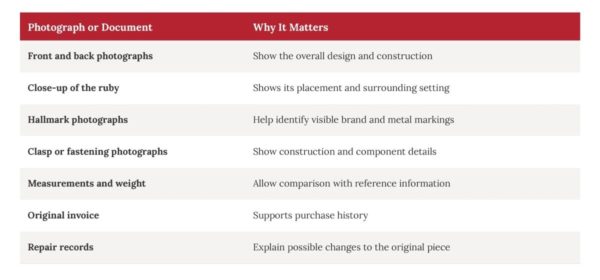
Use clear lighting and take close-up photographs without applying filters that alter the colour or appearance of the jewellery.
If you’re sharing receipts or ownership documents, obscure personal information such as addresses, payment details, and unrelated account information. These materials can help a specialist decide what needs further investigation. However, photographs cannot reliably replace a physical examination, especially when metal composition, gemstone identity, or construction requires testing.
8. When Should You Seek Professional Authentication?
If you’re purchasing an expensive pre-owned piece, dealing with inconsistent markings, or unable to establish the jewellery’s history, professional assistance is the most reliable next step. A qualified jeweller or appropriate specialist can examine details that may be difficult to assess through photographs, including metal composition, gemstone settings, and signs of repair or alteration.
It’s also helpful to understand that different jewellery assessments serve different purposes.
- Authenticity assessment: Investigates whether the piece is consistent with genuine Roberto Coin production.
- Condition assessment: Examines wear, damage, alterations, and repair requirements.
- Valuation or appraisal: Estimates the jewellery’s value for a specified purpose, such as insurance.
An appraisal does not automatically establish authenticity, and a condition report may not verify the original manufacturer. Before arranging an assessment, ask what the service includes, whether the examiner has experience with the brand and whether any written findings will be provided.
For guidance on the appropriate next step, you can visit Berani in Toronto or contact the team to ask what assessment information or professional referrals may be available. Authentication services or certificates should not be assumed without confirmation.
Buying Roberto Coin Jewellery in Canada: How to Reduce the Risk
If you’re shopping for Roberto Coin jewellery in Canada, choosing a seller carefully can reduce uncertainty before making a purchase.
Roberto Coin maintains an official network of retailers, and its Store Locator is a useful starting point for checking whether a business is currently listed as an authorized seller. If its status is unclear, contact the manufacturer directly for confirmation. An authorized retailer is particularly relevant when purchasing new jewellery. For pre-owned pieces, you’ll also want to understand the seller’s sourcing practices, documentation, and approach to authenticity claims.
Before purchasing, consider three questions:
- Can the seller explain the jewellery’s origin? Ask for a clear description of its purchase or ownership history.
- Does the product information match? Verify the collection, reference, gold colour, gemstones, and any published dimensions.
- What happens if a problem is discovered? Review the written return conditions, relevant purchase terms, and any representations about authenticity.
A store’s location in Canada does not, by itself, establish authenticity. Neither does a seller’s claim that a piece is genuine. For a significant purchase, comparing the documentation with the physical piece and seeking an independent assessment when appropriate can provide additional reassurance.
How Can You Tell If Roberto Coin Jewellery is Real?
Authenticating Roberto Coin jewellery involves looking at the complete picture rather than relying on a single signature feature.
The hidden ruby, hallmarks and recognizable collection motifs are useful starting points, but they should be considered alongside purchase history, design specifications, craftsmanship, and any previous alterations.
If a detail doesn’t match, investigate further before reaching a conclusion. An unusual hallmark, missing ruby, or unfamiliar design may have an explanation, particularly when dealing with older or repaired jewellery.
The most dependable approach is to buy from a verifiable source, retain your purchase documentation and seek qualified professional assistance whenever authenticity remains uncertain.
Frequently Asked Questions
1. Can Roberto Coin jewellery be genuine if its signature ruby was lost during a repair?
Yes, a missing ruby does not automatically mean the jewellery is counterfeit. A ruby may have been lost or replaced during previous work, and some authentic designs have documented exceptions. Review any repair records and have the setting examined professionally to determine whether the piece remains consistent with its claimed origin.
2. How can I authenticate a discontinued Roberto Coin design?
Start by identifying the collection and looking for dated catalogues, archived manufacturer information, or reputable retailer records. Older jewellery may no longer appear on the current website, so its absence is not evidence of counterfeiting. A qualified specialist can help compare the piece with historical designs and examine its construction.
3. Does a genuine Roberto Coin clasp prove that an entire necklace or bracelet is authentic?
No. A genuine clasp may have been attached to a repaired, altered, or assembled piece of jewellery. The entire necklace or bracelet should be examined, including its links, settings, markings, and overall construction. One authentic component cannot establish that every other part is original.
4. Can a jeweller authenticate Roberto Coin jewellery from photographs?
Photographs can support an initial evaluation, especially when they clearly show hallmarks, the signature ruby, and construction details. However, they may not reveal metal composition, gemstone identity, or alterations that require physical inspection. An opinion based only on images should not be treated as equivalent to a comprehensive examination.
5. Does an 18K gold stamp mean Roberto Coin jewellery is authentic?
No. An 18K or 750 marking indicates a claimed gold fineness, not the manufacturer. Such markings can also be copied. To assess authenticity, compare the metal stamp with the brand’s markings, the specific design, and its documented details. Professional testing may help establish the metal’s composition but does not independently confirm who made it.