
Omega Constellation Watch Guide: Models, Materials and Sizing
Choosing an Omega Constellation involves more than finding a dial colour you like. Within the collection, differences in case size, movement, metal, dial treatment, and diamonds can substantially change how a watch looks, feels and functions.
A compact quartz Constellation can have an understated, jewellery-like presence, while a larger automatic model puts more emphasis on traditional mechanical watchmaking. Stainless steel keeps the design relatively restrained, whereas two-tone gold and diamond details create a noticeably different effect.
Understanding these differences makes it easier to narrow down the collection and choose a Constellation that suits your wrist, personal style, and expectations for everyday ownership.
This Omega Constellation Guide is designed to help you look beyond dial colour and compare the differences that actually matter, including size, movement, materials, and overall wrist presence.
What Defines the Omega Constellation Collection?
The Constellation has been part of the broader range of Omega watches since 1952, when the collection was introduced with a strong focus on chronometric precision. Its identity has evolved considerably since then, but several details now make a modern Constellation immediately recognizable.
Among the best-known are the four claws, sometimes called “Griffes,” positioned around the case. The familiar Constellation design also incorporates half-moon facets at the ends of the case, while many models use bezels engraved with Roman numerals. The bracelet is another important part of the design, creating a continuous visual relationship between the case and bracelet rather than treating them as entirely separate elements.
These features have particularly strong roots in the Constellation Manhattan introduced in 1982. Modern versions reinterpret that design rather than simply reproducing it.
The collection is also unusually varied mechanically. Depending on the model, buyers can find both quartz and automatic movements. This makes the Constellation relevant to someone looking for an easy-to-own luxury watch as well as someone who specifically wants a mechanical OMEGA.
Omega Constellation Models and Sizes
Case diameter is an obvious starting point, but it should not be the only consideration. The shape of the case, bracelet integration, dial layout, and thickness all affect how a Constellation appears on the wrist.
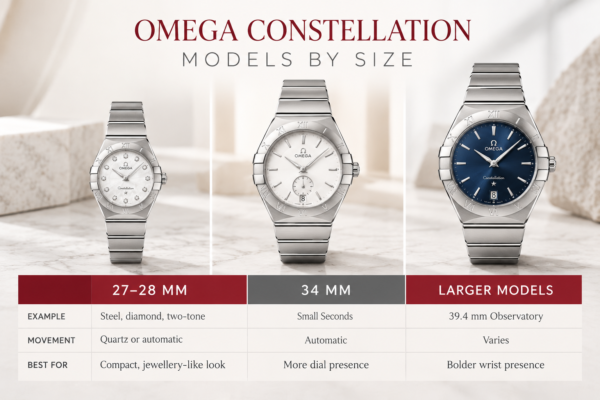
Compact Constellation Models
For buyers who prefer a smaller, more jewellery-oriented watch, the compact end of the collection offers several possibilities.
A good example available at Berani is the Omega Constellation 28 mm. It combines a 28 mm stainless steel case and bracelet with a white mother-of-pearl dial, Roman-numeral bezel and OMEGA Calibre 4061 quartz movement.
The same basic proportions can take on a noticeably different personality through the dial alone. Berani’s Omega Constellation 28 mm with diamonds retains the stainless steel construction and mother-of-pearl dial but adds diamond hour markers.
OMEGA has continued developing this compact category. Its 2025 additions included 25 and 28 mm Constellations powered by Calibre 4061, demonstrating that smaller sizes remain an active part of the collection rather than simply belonging to earlier generations.
Berani also carries a 27 mm automatic Constellation with a mother-of-pearl diamond dial. Unlike the 28 mm quartz examples, it uses OMEGA’s Co-Axial Master Chronometer Calibre 8704 and offers a small-seconds display and date. It is a useful reminder that case size alone does not tell you what is inside a Constellation.
34 mm Constellation Models
Moving to 34 mm gives the watch greater visual presence while retaining the refined character associated with the collection.
Berani’sOmega Constellation 34 mm Small Seconds is a particularly useful comparison with the smaller quartz models. It is an automatic stainless steel watch powered by the Co-Axial Master Chronometer Calibre 8802.
Its dial incorporates a small-seconds subdial as well as a date window at 6 o’clock, while the movement can be viewed through the sapphire crystal caseback. The result is a Constellation that puts considerably more emphasis on mechanical watchmaking without adopting the proportions of a large sport watch.
Larger Constellation Models
The collection extends beyond these compact and mid-sized examples. OMEGA has produced larger Constellations in several generations and in 2026 introduced the 39.4 mm Constellation Observatory collection.
Rather than treating a particular diameter as universally “small” or “large,” consider how the entire watch covers your wrist. Case length, thickness, bracelet shape, and taper can matter alongside diameter.
Whenever possible, try adjacent sizes in person. An integrated-style bracelet and distinctive case geometry can make a Constellation wear differently from a conventional round watch on a leather strap.
How to Choose the Right Omega Constellation Size
As this Omega Constellation guide shows, there is no single case diameter that is correct for a particular wrist measurement.
A more useful approach is to decide what visual effect you want.
If you prefer a discreet watch that can sit comfortably alongside bracelets or other jewellery, compact models may make the most sense. If you want the dial and mechanical details to play a larger visual role, a 34 mm or larger model may be more suitable.
Readability matters as well. A smaller watch may have ideal proportions for your wrist but not provide the dial visibility you prefer.
When trying on a Constellation, pay attention to:
- how much of your wrist the case and bracelet occupy;
- whether the dial is easy for you to read;
- how the bracelet sits and articulates;
- the watch’s thickness as well as its diameter; and
- whether you plan to wear it alone or with other jewellery.
The objective is proportion and comfort rather than following a rigid sizing formula.
Omega Constellation Materials Explained
Material is one of the biggest visual differences between Constellation models and can also have a substantial effect on price.
Stainless Steel
Stainless steel offers one of the most versatile expressions of the Constellation design. It keeps attention on the case shape, dial, and bracelet and pairs easily with both casual and formal wardrobes.
Berani’s current selection demonstrates that steel is not limited to one type of Constellation. It appears on compact quartz watches as well as automatic models such as the 34 mm Small Seconds.
Steel is durable, but that does not mean it is scratch-proof. Polished and brushed surfaces can both accumulate marks through normal wear.
Steel and Gold
Two-tone Constellations introduce warmer colour without committing the entire watch to precious metal.
For example, Berani’s two-tone Omega Constellation 28 mm combines stainless steel with OMEGA’s 18K Sedna™ Gold. Another 28 mm version pairs steel with 18K yellow gold.
These models can be particularly appealing to someone who regularly wears both white- and yellow- or rose-toned jewellery. They also demonstrate why two watches of identical diameter can occupy different price categories.
Precious-Metal Constellations
OMEGA also produces Constellations in precious metals. These place much greater visual emphasis on the material itself and move the collection further toward fine-jewellery territory.
The exact alloy matters. OMEGA uses several proprietary precious metals across its current watches, including Sedna™ Gold, Moonshine™ Gold and Canopus Gold™. Buyers should therefore check the specifications of the individual model rather than assuming that every gold-coloured Constellation uses the same material.
Gold also requires realistic expectations about wear. Its polished surfaces can acquire scratches and marks, and refinishing should be approached carefully to preserve the original case geometry.
Diamond-Set Constellations
Diamonds can change the character of a Constellation without changing its dimensions.
Berani’s steel 28 mm diamond model, for instance, uses diamond hour markers against a white mother-of-pearl dial. Its case size and movement are shared with the non-diamond steel example, yet the overall appearance is considerably more jewellery-focused.
Diamond treatments vary between models. Depending on the watch, diamonds may appear as hour markers, on the bezel, or in more elaborate configurations. If you are considering a diamond Constellation, compare the amount and placement of the stones rather than simply looking for the word “diamond” in the description.
Quartz vs. Automatic Omega Constellation
Movement choice is another important decision, but quartz and automatic Constellations should be viewed as different ownership experiences rather than as a simple hierarchy.
The Calibre 4061 found in Berani’s 28 mm quartz models provides a practical option for someone who prioritizes convenience and accurate timekeeping with relatively little day-to-day attention. For readers unfamiliar with the technology, our guide to quartz watches explains how these movements work and what ownership involves.
Automatic Constellations appeal for different reasons. The 34 mm Small Seconds, for example, uses the Co-Axial Master Chronometer Calibre 8802, offers approximately 50 hours of power reserve, and displays the movement through its sapphire crystal caseback.
Interestingly, Berani’s 27 mm diamond Constellation demonstrates that automatic does not necessarily mean large: its Calibre 8704 is housed in a compact 27 mm case.
Movement type can also affect price, but it is only one factor. Diamonds, precious metals, dial construction, and bracelet materials all matter. When comparing Omega watch prices in Canada, compare similar configurations rather than assuming that a larger watch must cost more.
Constellation vs. Other Omega Collections
The Constellation makes the most sense for buyers who specifically appreciate its distinctive case and bracelet design.
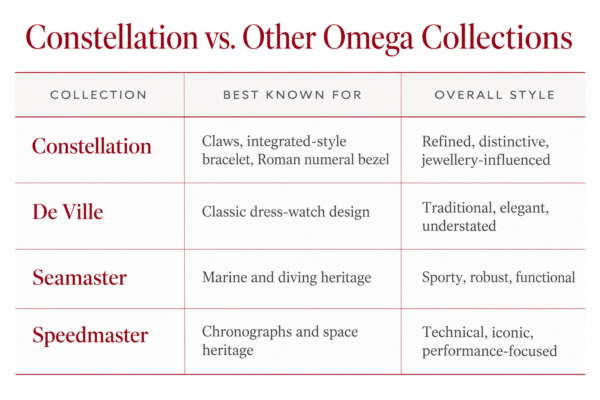
Within OMEGA’s more refined offerings, the De Ville generally follows a more traditional dress-watch approach. A Constellation is usually easier to identify at a glance because of details such as its claws, half-moon case facets, and characteristic bracelet design.
The distinction becomes clearer against OMEGA’s sport-oriented families. Seamaster watches draw heavily on the brand’s marine and diving heritage, while the Speedmaster is closely associated with chronographs and space exploration.
The right collection therefore depends less on which is “better” and more on the design language, functionality, and history you want from an OMEGA.
What to Check Before Buying an Omega Constellation
Once you have narrowed your choice by size, material, and movement, check the specifications of the individual watch rather than assuming that every Constellation from the same size category is identical.
Confirm the exact case dimensions, movement, dial, case and bracelet materials, water-resistance rating, and diamond configuration where applicable. Specifications can differ significantly between generations and models.
This becomes especially important when considering a pre-owned Constellation. Examine the condition of the dial, crystal, case, bracelet, and clasp, and ask about service history. Boxes, warranty cards, and other documentation are valuable supporting information, but they should not be treated as the sole basis for determining a watch’s authenticity or condition.
The main takeaway from this Omega Constellation Guide is that the right watch depends on the full combination of size, movement, materials, dial design, and how the watch feels on your wrist.
Rather than choosing based on one specification alone, compare the details that matter most to your preferences and everyday wear. To explore different models, materials, and sizes in person or online, browse Berani Jewellers’ selection of Omega watches and compare the Constellation options currently available.
Frequently Asked Questions
1. Is the Omega Constellation Mainly a Women’s Watch?
No. The Constellation has been produced in a broad range of sizes and configurations. OMEGA’s history includes both compact jewellery-oriented pieces and larger models, including vintage 33 mm Manhattan watches and the modern 39.4 mm Constellation Observatory. Choose according to proportions and design preference rather than treating the collection as restricted to one gender.
2. Is a Quartz Omega Constellation Still a Luxury Watch?
Yes. Movement type does not determine whether a watch is a luxury product. OMEGA’s quartz Constellations can include mother-of-pearl dials, precious-metal components, diamonds, sapphire crystals, and the same recognizable Constellation design language found throughout the collection.
3. Can an Omega Constellation Bracelet Be Resized?
Many Constellation bracelets can be resized by adding or removing links. The exact adjustment available depends on the bracelet and model. Some recent Constellation bracelets also include a comfort-adjustment system. Professional sizing is recommended.
4. Are Diamond Omega Constellation Watches Factory-Set?
OMEGA produces factory diamond-set Constellation models. When purchasing a specific watch, particularly a pre-owned example, confirm that its diamond configuration matches the original specifications for that model.
5. Does a Larger Omega Constellation Always Cost More?
No. Size is only one pricing factor. Movement, case and bracelet material, diamonds, and dial treatment can have an equal or greater effect on price. A smaller diamond-set or gold Constellation can therefore cost more than a larger steel model.