
Omega Seamaster Watch: A Guide to Modern and Vintage Models
Few names in Swiss watchmaking cover as much territory as the Omega Seamaster. Introduced as a robust everyday watch, the collection has grown to include refined daily timepieces, professional dive watches, and models engineered for extreme depths.
That variety makes choosing an Omega Seamaster watch exciting but potentially confusing. An Aqua Terra, Diver 300M, and Ultra Deep may share the Seamaster name, yet they offer very different designs, proportions, and capabilities. Meanwhile, the Omega Seamaster vintage watch attracts collectors seeking traditional dimensions and a tangible connection to the brand’s history.
This guide explains how the Seamaster evolved, how its principal modern collections differ and what buyers should consider before choosing a modern or vintage model.
From Everyday Watch to Diving Icon
Omega introduced the Seamaster in 1948. Unlike the purpose-built divers that would follow, the original models were designed as durable, water-resistant watches for everyday life. Their construction drew on Omega’s experience supplying watches to British military personnel during the Second World War.
The collection entered a new era in 1957 with the launch of the Seamaster 300. Released alongside the original Speedmaster and Railmaster, it was created for underwater professionals and recreational divers. Its legible dial, rotating timing bezel, and diving-focused construction established a visual language that continues to influence Omega’s heritage models.
In 1993, Omega introduced the Seamaster Professional Diver 300M. Its wave-pattern dial, skeletonized hands and distinctive helium-release valve created a more contemporary identity. The collection later became closely associated with James Bond, beginning with GoldenEye in 1995.
Today, Seamaster does not describe one watch. It encompasses everything from the understated Aqua Terra to the 6,000-metre Ultra Deep.
Which Modern Omega Seamaster is Right for You?
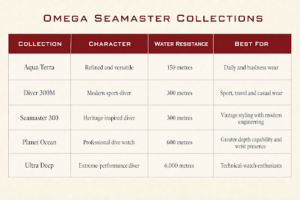
The easiest way to choose a Seamaster is to begin with how and where it will be worn.
Specifications can vary by reference and should be confirmed before purchase.
Aqua Terra: The Everyday Seamaster
The Aqua Terra is an excellent starting point for buyers who want Seamaster engineering without a traditional diving bezel. Its clean case and balanced dial allow it to move comfortably between casual clothing and more formal settings.
Size plays an important role. A34 mm Aqua Terra offers a compact presence, while theAqua Terra 38 mm provides a versatile middle ground. The41 mm Aqua Terra creates a sportier impression on the wrist.
Frequent travellers can also consider theAqua Terra GMT Worldtimer, which displays world time through a more elaborate dial. Standard Aqua Terra models are rated to 150 metres, reinforcing their role as genuinely capable everyday watches rather than purely dress-focused pieces.
Diver 300M: The Recognizable Modern Diver
For many buyers, the Diver 300M is the definitive modern Omega Seamaster watch. Current time-and-date models commonly combine a 42 mm case with 300 metres of water resistance, a unidirectional diving bezel and a helium-release valve.
Many references feature laser-engraved wave dials, luminous skeletonized hands, and ceramic components. Colour substantially changes the watch’s personality: Berani selections include the Diver 300M withblack,blue,white, andgreen dials.
A steel bracelet produces the collection’s familiar technical-luxury appearance. Rubber can make the same watch feel lighter and more casual, while chronograph versions are larger and visually more complex.
Seamaster 300: Vintage Character, Modern Construction
Despite their similar names, the Seamaster 300 and Diver 300M are separate collections. The Seamaster 300 looks further back in Omega’s history, using a simpler dial, broad luminous markers, and heritage-influenced details.
TheSeamaster 300 Co-Axial Master Chronometer 41 mm is particularly relevant to buyers who appreciate vintage design but want modern water resistance, movement technology, and daily reliability. It provides historical character without many of the uncertainties associated with owning a decades-old watch.
Planet Ocean and Ultra Deep: Greater Depth and Presence
Planet Ocean models occupy the more substantial side of the Seamaster family. Standard versions offer 600 metres of water resistance and a bold professional-diving aesthetic. Buyers should consider thickness, weight, and lug-to-lug length, not only case diameter, because these watches can wear larger than their measurements initially suggest.
The Ultra Deep takes the concept much further. Production models such as theSeamaster Ultra Deep 6000M are rated to 6,000 metres. That capability exceeds normal recreational needs, but it demonstrates the engineering ambitions behind the collection.
Why Vintage Omega Seamaster Watches Remain Appealing
A vintage Seamaster can look very different from a modern dive watch. Many examples from the 1950s and 1960s have slim cases, restrained dials, and modest dimensions. Their appeal lies in that understated character, combined with the enormous variety of references produced over several decades.
Aging can give each watch an individual appearance. Luminous material may darken, silver dials may develop warmer tones, and cases may show evidence of years of wear. Collectors often call this patina, but age alone does not make a watch desirable. Condition, originality, and the quality of the aging matter.
A vintage Seamaster also requires more careful investigation. Buyers should verify the case reference and movement serial number, examine whether the dial has been refinished, and identify replaced hands, crowns, or other service components. A heavily polished case may have lost its original lines, while an attractive dial may not be original to that reference.
Service history is equally important. A mechanically sound, properly maintained watch may be a better purchase than a cosmetically perfect example with an unknown movement condition.
Modern or Vintage: Which Should You Choose?
- Choose a modern Seamaster if you want dependable water resistance, contemporary movement technology, manufacturer support, and a watch suited to frequent wear. Modern models also offer clearer specifications and more predictable ownership.
- Choose an Omega Seamaster vintage watch if you value period design, smaller proportions, and the individuality of an older timepiece. Be prepared for specialist servicing and more extensive authentication research.
Most importantly, never assume that a vintage watch remains waterproof because it was water-resistant when new. Gaskets deteriorate, components wear, and cases can be compromised. A qualified watchmaker should inspect and pressure-test any vintage Seamaster before it is exposed to water. Many collectors avoid swimming with vintage watches entirely.
A Seamaster for Nearly Every Kind of Buyer
The lasting strength of the Seamaster is its range. The Aqua Terra offers discreet versatility, the Diver 300M delivers a recognizable sporting identity, the Seamaster 300 combines heritage cues with modern capability, and the Planet Ocean and Ultra Deep emphasize serious diving performance.
Before purchasing, compare case dimensions, water resistance, bracelet or strap options and intended use. Vintage buyers should add originality, provenance, and movement condition to that checklist.
Whether you prefer a contemporary professional diver or a restrained mid-century watch, the Seamaster offers a meaningful combination of Omega heritage, Swiss engineering, and distinctive design.
When comparing Omega watch dealers in Toronto, buyers can explore Berani’s available Seamaster models and confirm current specifications, pricing and availability.
Frequently Asked Questions (FAQs)
Is the Omega Seamaster a dive watch?
Some Seamaster models are purpose-built dive watches, but not every Seamaster belongs to that category. The Diver 300M, Seamaster 300, Planet Ocean, and Ultra Deep are diving-focused collections. The Aqua Terra is a versatile sports watch designed for everyday wear, although standard models still offer 150 metres of water resistance.
What is the difference between the Seamaster 300 and Diver 300M?
They are separate collections. The Seamaster 300 draws inspiration from Omega’s 1957 professional diving watch and has a more restrained, heritage-influenced appearance. The Diver 300M, introduced in 1993, has a more contemporary design characterized by features such as skeletonized hands, a helium-release valve, and wave-pattern dials on many references.
How old is the Omega Seamaster collection?
Omega introduced the Seamaster in 1948 as a durable, water-resistant watch for everyday use. The purpose-built Seamaster 300 followed in 1957. This long history helps explain why modern and vintage Seamaster watches can differ significantly in design and function.
Are vintage Omega Seamaster watches valuable?
Some vintage Seamaster watches can be valuable, but age alone does not determine price. Reference, rarity, dial condition, case condition, originality, movement health, and provenance all influence desirability. Unusual models in well-preserved condition may attract collector interest, while watches with refinished dials or mismatched components may be less desirable.
How can I tell if a vintage Omega Seamaster is authentic?
Check the case reference, movement serial number, and calibre against reliable reference information. Inspect the dial printing, hands, crown, and movement markings, and look for evidence of refinishing or replacement components. Because legitimate service parts are common, authenticity is not always determined by a single detail. Valuable or uncertain watches should be examined by an experienced watchmaker or vintage Omega specialist.
Are vintage Omega Seamaster watches waterproof?
A vintage Seamaster should not be assumed to remain waterproof. Seals and gaskets deteriorate, while previous servicing, corrosion, or case damage can affect water resistance. Have the watch inspected and pressure-tested before any exposure to water. Even after testing, many collectors choose not to swim with vintage watches.
Is an Omega Seamaster suitable for everyday wear?
Yes, provided the model suits the wearer’s routine. The Aqua Terra is particularly versatile for business, travel, and casual use. The Diver 300M offers a sportier everyday option, while Planet Ocean and Ultra Deep models have greater thickness and weight that may not suit every wrist.
Which Omega Seamaster size should I choose?
Consider wrist circumference, case diameter, thickness, and lug-to-lug length. Aqua Terra models in 34 mm and 38 mm generally provide a more compact fit, while 41 mm and 42 mm watches have greater presence. Planet Ocean and Ultra Deep models may wear especially large because of their thickness and weight. Trying the watch on is the most reliable way to assess comfort.
Is a modern or vintage Omega Seamaster better?
Neither is universally better. A modern Seamaster is generally preferable for frequent wear, known water resistance, and contemporary movement technology. A vintage Seamaster may appeal more to buyers who value period styling, smaller proportions, and collector character. The right choice depends on intended use and willingness to manage maintenance.
Is an Omega Seamaster a good watch for collectors?
The Seamaster’s long history, broad range of references and combination of iconic and lesser-known models make it an interesting collection to explore. However, buyers should prioritize authenticity, condition, and personal enjoyment rather than relying on future appreciation. The best Seamaster is one that fits both the owner’s preferences and intended use.