
Vhernier Jewellery History: The Story Behind the Italian Luxury Brand
Vhernier occupies an unusual place in Italian fine jewellery. Rather than building its identity around elaborate ornament or prominent logos, the Milanese Maison is known for smooth volumes, clean lines and pieces that often resemble miniature sculptures.
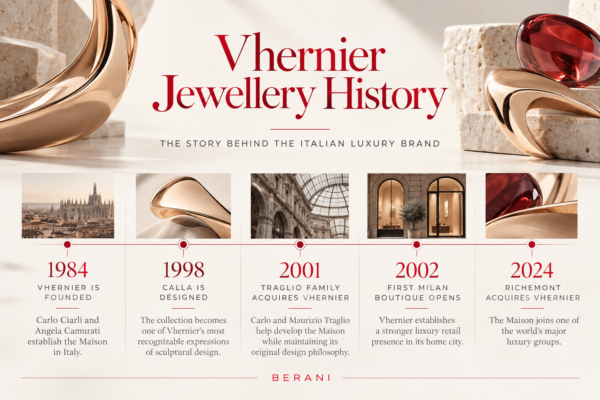
The story began in 1984, when Italian sculptor Carlo Ciarli and Angela Camurati founded Vhernier. Since then, the Maison has developed a recognizable approach to jewellery based on form, movement, colour and the relationship between a piece and the body.
Understanding Vhernier jewellery history therefore means looking not only at dates and ownership changes, but also at how this distinctive design language developed.
Vhernier at a Glance
How Vhernier Began
Angela Camurati and sculptor Carlo Ciarli launched Vhernier in 1984. Ciarli’s sculptural background helps explain one of the defining characteristics of Vhernier jewellery: shape is not simply a framework for gemstones. The shape itself can be the design. The Maison continues to describe modern sculpture as one of the principal influences behind its clean, simplified forms.
Its early creations attracted Carlo Traglio, an art collector and aesthete who was drawn to their simplicity and expressive quality. The Traglio family acquired Vhernier in 2001, and Carlo and his brother Maurizio played an important role in developing the company into a more established jewellery Maison. Vhernier nevertheless continued to build on the founders’ original vision rather than replacing it.
The first mono-brand Vhernier boutique opened in Milan in 2002. International expansion followed, while the Maison maintained a relatively selective retail presence. Vhernier now operates boutiques in major luxury destinations including Milan, Paris, New York, Beverly Hills, Dubai and Hong Kong. Readers can view the Maison’s current locations through its official Vhernier boutique directory.
What Makes Vhernier Jewellery Different?
Sculpture has remained central throughout Vhernier jewellery history. Curves, proportions and volumes are carefully considered so that the jewellery interacts with the body instead of simply sitting on it.
This approach can be seen in the Maison’s use of polished gold. Gold is often formed into rounded, substantial surfaces that become a visual feature themselves rather than serving only as a setting for diamonds or coloured stones.
Vhernier also experiments with less conventional combinations of materials. Richemont describes the Maison as combining precious metals and gemstones with materials including titanium, bronze and ebony.
Rock Crystal and Vhernier’s Trasparenze
One particularly recognizable technique is Vhernier’s use of transparent rock crystal over another material. Instead of seeing only the underlying colour, the viewer sees it through the clear layer, adding depth and altering its visual effect.
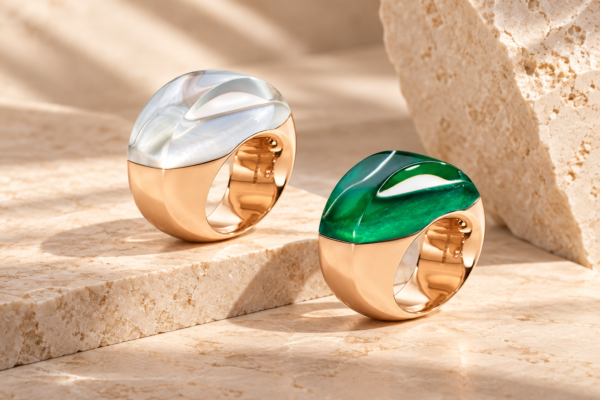
A practical example is Berani’s Vhernier Aladino ring, which combines 18K rose gold, white mother-of-pearl and rock crystal. Rather than treating each material as a separate decorative element, the design uses them together to create colour, transparency and volume.
This kind of material experimentation is important to the wider story of Vhernier because it demonstrates how the Maison can make colour prominent without abandoning its restrained, sculptural aesthetic.
The Collections That Help Define Vhernier
Several collections show particularly clearly how Vhernier’s design principles have evolved.
Calla
Calla was designed in 1998 and initially conceived as a necklace. Its repeating forms are based on the conical shape of the calla lily, reduced to a highly simplified abstraction.
Those sequential elements create rhythm and movement while curving around the body. Vhernier itself describes Calla as an expression of the Maison’s sculptural origins, making it an important collection when examining Vhernier jewellery history.
Abbraccio
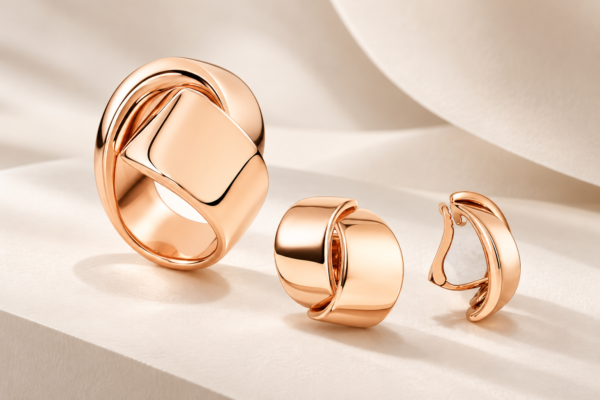
Abbraccio takes a different approach to the same sculptural philosophy. Smooth forms overlap and appear to wrap around one another, giving the jewellery its sense of movement without requiring elaborate decoration.
The Vhernier Abbraccio Ring in 18K rose gold is a good example. Its asymmetrical, rounded form allows polished gold and proportion to become the main visual elements.
The same idea carries into the Vhernier Abbraccio Earclips, where overlapping rose-gold bands create a dimensional silhouette that changes as it catches the light.
Aladino
Aladino highlights another side of the Maison: its interest in colour and transparency.
Selected pieces layer rock crystal with materials such as jade or mother-of-pearl. Berani currently carries Aladino references using both combinations, including a jade-and-rock-crystal design and a white-mother-of-pearl-and-rock-crystal design.
These pieces show why Aladino is useful for understanding Vhernier’s aesthetic. The colour may immediately attract attention, but the overall impression still depends heavily on shape, polished surfaces and carefully controlled volume.
Vhernier Joins Richemont
One of the most important recent events in Vhernier jewellery history came in 2024.
Richemont announced an agreement to acquire Vhernier in May 2024 and completed the acquisition in September. Vhernier consequently joined a luxury group whose jewellery portfolio also includes major Maisons such as Cartier, Van Cleef & Arpels and Buccellati.
The change gives Vhernier the backing of a much larger international luxury group, but its core identity remains centred on distinctive, sculptural Italian jewellery. Richemont itself continues to highlight the Maison’s modern aesthetic, ergonomic forms and unusual material combinations as defining characteristics.
Why Vhernier Appeals to Modern Jewellery Collectors
Vhernier offers something different for buyers who appreciate jewellery but do not necessarily want a design dominated by a recognizable logo, conventional gemstone setting or traditional motif.
Its pieces tend to be identifiable through design instead: a particular curve, a polished volume, an unusual material combination or the way a piece follows the body.
That can make Vhernier especially appealing to people interested in architecture, sculpture and contemporary design. Collections such as Abbraccio demonstrate how much can be achieved through gold and form alone, while Aladino shows how colour and optical effects can be incorporated without overwhelming the underlying shape.
Exploring Vhernier Jewellery in Toronto
Vhernier’s sculptural approach is also a reason to see the jewellery in person whenever possible. Photographs can show colour and overall shape, but they do not always communicate scale, weight, curvature or how a piece sits against the body.
Berani Jewellers carries selected Vhernier pieces in Toronto, including designs from Abbraccio and Aladino. Buyers can also explore Berani’s wider selection of designer jewellery or visit the Bayview Village boutique to compare pieces in person.
From its beginnings in 1984 to its place within Richemont today, Vhernier jewellery history has remained closely connected to one central idea: jewellery can be approached as sculpture. That consistency is what makes Vhernier recognizable, even when the materials, colours and individual collections change.
Frequently Asked Questions
1. Is Vhernier an Italian jewellery brand?
Yes. Vhernier was founded in Italy in 1984 and is headquartered in Milan. Its jewellery is handcrafted in Valenza, an important centre of Italian jewellery production.
2. Who founded Vhernier?
Vhernier was founded in 1984 by Italian sculptor Carlo Ciarli and Angela Camurati. The Traglio family later acquired the Maison.
3. When did the first Vhernier boutique open?
Vhernier opened its first mono-brand boutique in Milan in 2002.
4. Is Vhernier owned by Richemont?
Yes. Richemont completed its acquisition of Vhernier in September 2024.
5. What is Vhernier known for?
Vhernier is known for sculptural jewellery with clean lines, rounded volumes and designs inspired by the human body and modern sculpture. The Maison also uses unusual combinations of traditional precious materials and less conventional materials.
6. What is special about Vhernier Aladino jewellery?
Selected Aladino designs combine coloured or iridescent materials such as jade or mother-of-pearl with transparent rock crystal. This creates depth and optical effects while maintaining the smooth, sculptural forms associated with Vhernier.