
Fake Cartier Watch vs. Real: How to Check for Authenticity
A Cartier watch is more than a timepiece. It is a piece of design history, recognized for its distinctive shapes, refined finishing, and instantly recognizable style. From the rectangular elegance of the Tank to the bold character of the Santos and the jewellery-inspired appeal of the Panthère, Cartier watches have remained highly desirable among collectors and luxury watch buyers.
Because of this popularity, many buyers ask: How do I know if my Cartier watch is real?
Modern replicas have become increasingly sophisticated. Some counterfeit watches can imitate visible details that once made them easy to identify, which is why checking only one feature, such as a serial number, logo, or box, is not enough.
The safest way to evaluate a Cartier watch is to look at the complete picture: the seller’s reputation, the watch’s reference details, finishing, movement, documentation, and professional inspection when needed.
This guide explains the most important things to look for when comparing a fake Cartier watch vs. a real one, and why no single detail should be treated as absolute proof.
The Safest Way to Confirm Whether a Cartier Watch is Real
Before you even pick up a loupe, do the boring part first: check the seller. Who are they, how long have they been selling watches, and can they answer specific questions about the exact reference without hesitating? A credible seller will happily share close-up photos, provide the invoice or service history they have, and won’t rush you into paying.
Online serial-number lookups and reverse image searches have their place; they’re a good first filter, but they aren’t official authentication, and they were never meant to be. The only way to get real certainty is an in-person inspection by someone qualified: an experienced watchmaker, a Cartier service channel, or a specialist who can open the case, examine the movement, and compare it against documented references. If you’re about to buy, insure, service, or resell a watch and the answer genuinely matters, that inspection is worth the time. For a broader look at counterfeit red flags across watch brands, our guide on how to spot a fake watch is a useful companion read.
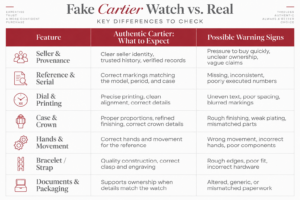
Quick Comparison: Cartier Fake vs. Real
Use this as a checklist, not a scorecard. A watch that passes five checks and fails one still deserves a second look, and a watch with one unusual detail isn’t automatically fake.
1. Start With the Seller and the Paper Trail
Most authentication problems reveal themselves before you ever look at the watch. Ask for the original invoice, any service records, and if it’s changed hands more than once, a sense of who owned it before. A seller willing to let you arrange an independent inspection is telling you something good; one who refuses is telling you something else.
Watch for prices well below what the model typically commands, listing photos that look like stock images rather than the actual item, and vague answers to direct questions. None of these prove a watch is counterfeit by themselves; a below-market price can simply mean a motivated seller, but stacked together, they’re worth pausing over. If you’re shopping for a specific model and want to make sure you’re comparing apples to apples, our Cartier watch buying guide covers how to narrow down the right reference before you commit.
2. Get the Reference and Serial Number Right
Cartier watches include identifying markings that help connect the physical watch to its model and production history.
However, it is important to understand the difference between:
- Reference number: identifies the watch model and configuration
- Serial number: identifies an individual watch
A serial number that appears legitimate does not automatically confirm authenticity. Counterfeiters can copy genuine-looking numbers, which is why the number must match the entire watch.
Check whether:
- The reference matches the case shape and materials
- The movement type matches the model
- The size and configuration correspond with known Cartier specifications
- The markings appear professionally executed
Different Cartier collections and production periods may have variations, so comparisons should always be made against the correct reference.
3. Study the Dial Closely
The dial is usually where the most convincing counterfeits still slip up. Look at the printing quality and alignment, the spacing of the Roman numerals, the minute track, and, on models that have one, the date window placement. Many Cartier dials feature a fine guilloché texture that’s genuinely difficult to reproduce accurately; if it looks flat, uneven, or absent where it should be present, that’s worth noting.
A magnifier can help you catch printing that looks fuzzy or slightly off-center. But be careful about jumping to conclusions: vintage pieces can show honest wear, some dials have been legitimately refinished over the years, and factory service parts exist. Compare only against the same reference or a well-documented variant from the same period, and don’t attempt to open the case yourself to inspect further.
4. Check the Case, Crown, and Screws
Luxury watches are defined by details that are difficult to replicate perfectly.
When examining a Cartier watch, look at:
- Case proportions
- Polishing and brushing quality
- Screw finishing
- Crown design
- Cabochon appearance
The crown is an especially recognizable Cartier feature. Depending on the model, Cartier watches may use different crown designs and materials, so it should always be compared against the correct reference.
Weight can sometimes provide context, but it should never be used as the only authentication method. Different metals, case sizes, bracelets, and movements naturally change the weight of a watch.
The Santos de Cartier, for instance, is known for its distinctive square case and exposed screws, a design signature that’s specific enough to make inconsistencies fairly obvious once you know what to look for. We carry a few Santos models, including a steel and yellow gold version with interchangeable metal and leather straps, if you’d like a genuine reference point to compare against.
5. Look at the Bracelet, Strap, and Clasp
The bracelet or strap is an important part of Cartier’s design identity.
Look for:
- Smooth bracelet movement
- Consistent finishing
- Quality of screws and links
- Clasp construction
- Correct engraving details
This is particularly important with models where the bracelet is central to the design.
The Panthère de Cartier watch is a great example. Its bracelet is not simply a functional component; it is part of the watch’s jewellery-inspired character. The fluid construction and finishing contribute significantly to the overall appearance of the piece.
Keep in mind that straps can be replaced over time. A non-original strap does not automatically mean a watch is fake.
6. Understand the Movement Before You Judge the Ticking
One common misconception is that a ticking seconds hand automatically means a Cartier watch is fake.
This is incorrect.
Cartier produces watches with different movement types, including:
- Quartz movements
- Automatic movements
- Manual-winding movements
For example, many Panthère models use quartz movements, while other Cartier collections include mechanical options depending on the reference.
Before judging the movement, confirm what movement the specific watch should have.
Our guide to different watch movement types explains how quartz, automatic, and manual movements differ.
7. Treat Boxes and Papers as Supporting Evidence, Not Proof
Documentation can support a watch’s history, but it should never be considered the only proof of authenticity.
Original papers may help confirm:
- Purchase history
- Model information
- Service records
- Ownership timeline
However:
- Boxes can be replaced
- Papers can be altered
- Documentation can be separated from the original watch
At the same time, a missing box or certificate does not automatically mean the watch is counterfeit.
The watch itself must always be evaluated together with the supporting information.
Common Cartier Authentication Mistakes
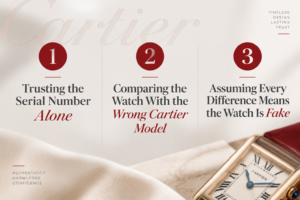
Mistake 1: Trusting the serial number alone
A serial number is useful, but it is only one piece of information. Authenticity depends on whether all elements of the watch match together.
Mistake 2: Comparing the watch with the wrong Cartier model
A Santos, Tank, and Panthère all have different design characteristics.
A detail that is correct for one collection may not apply to another.
Mistake 3: Assuming every difference means the watch is fake
Legitimate watches can have:
- Service replacements
- Changed straps
- Polished cases
- Vintage variations
Professional evaluation is important before reaching conclusions.
What to do if You Think Your Cartier Watch is Fake
If you suspect a Cartier watch may not be authentic:
- Do not open or modify the watch yourself
- Keep all receipts, messages, and purchase information
- Save photos and details from the original listing
- Avoid further transactions until the watch is reviewed
- Seek an assessment from a qualified luxury watch professional
Taking a careful approach protects both your investment and the watch itself.
How to Buy a Cartier Watch With More Confidence
The best way to reduce the risk of purchasing a counterfeit watch is to make informed decisions from the beginning.
Before buying:
- Research the exact Cartier collection and reference
- Understand the expected materials and movement
- Choose a reputable seller
- Review available documentation
- Ask questions before completing the purchase
For buyers exploring pre-owned options, our guide on buying a pre-owned luxury watch in Canada covers important considerations before purchasing a high-value timepiece.
Whether you prefer the elegant lines of the Tank Louis Cartier, the iconic shape of the Santos, or the refined jewellery style of the Panthère, understanding the details of each collection helps you choose with confidence.
Explore Berani’s selection of authentic Cartier watches to discover timeless designs from one of the world’s most recognized luxury watchmakers.
Protecting and Caring for Your Cartier Watch
Once you own an authentic Cartier watch, proper care helps preserve its beauty and performance.
Important steps include:
- Keeping purchase records and service documents
- Storing the watch safely when not worn
- Following recommended servicing intervals
- Avoiding unnecessary exposure to moisture or impacts
Learn more with our guide on how to care for a luxury watch.
For valuable timepieces, insurance may also provide additional protection. Our guide on watch insurance in Canada explains what owners should consider.
Final Cartier Authenticity Checklist
- Confirm the exact model, reference, era, and movement type
- Assess the seller and ownership history
- Compare dial, case, crown, hands, bracelet, and engravings against the correct reference
- Treat serial numbers, boxes, and papers as supporting evidence, not proof on their own
- Never open the watch without appropriate professional expertise
- Get an in-person professional assessment when certainty genuinely matters
Authentication isn’t about finding one smoking gun; it’s about building a consistent picture from several details at once.
FAQs
How do I know if my Cartier watch is real?
The most reliable approach is to evaluate the seller, reference details, watch construction, movement, and documentation together. A professional inspection is recommended when authenticity affects a major purchase or resale decision.
Can a fake Cartier watch have a serial number?
Yes. Counterfeit watches can include copied or fabricated serial numbers. A serial number should always be checked alongside the model, movement, finishing, and other details.
Does a Cartier watch tick?
Some Cartier watches use quartz movements and may have a ticking seconds hand. The movement type depends on the specific Cartier reference.
Can Cartier watches have quartz movements?
Yes. Cartier has produced quartz models across several collections, including many elegant women’s watches such as certain Panthère and Tank references.
Does a Cartier box and certificate prove authenticity?
No. Documentation can support ownership history, but boxes and certificates can be separated from watches or reproduced. The watch itself must also match the expected specifications.
Where can I verify a Cartier watch in Canada?
For important purchases, buyers should seek evaluation from qualified luxury watch professionals, experienced watchmakers, or authorized service channels that can inspect the watch properly.