
Omega Constellation vs. De Ville: Which Dress Watch Is Right for You?
The Omega Constellation and De Ville are two distinctive choices for anyone looking for an elegant Swiss watch. The Constellation stands out for its recognizable case design and integrated-style bracelet options, while the De Ville offers a broader range of traditional dress-watch designs, from understated everyday pieces to more elaborate mechanical watches.
But which one belongs on your wrist? This Omega Constellation vs. De Ville comparison explores their designs, movements, proportions, styling, and prices to help you choose a watch that suits your preferences and lifestyle.
Omega Constellation vs. De Ville: The Main Differences
At first glance, both collections offer the craftsmanship and refined appearance associated with Omega. However, their design philosophies are noticeably different.
The Constellation is known for its distinctive case architecture, including the signature claws on many modern models. De Ville takes a more traditional approach to dress-watch design, with round cases, classic dials, and a variety of strap and bracelet configurations.
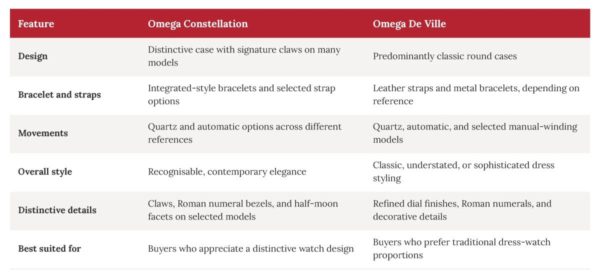
The biggest difference is visual identity. A modern Constellation often makes a stronger design statement, while many De Ville models favour a more restrained appearance. Neither collection is limited to formal occasions, and the exact reference matters more than the collection name when comparing specifications.
The Omega Constellation: A Dress Watch With a Distinctive Identity
The Constellation has been part of Omega’s collection since 1952, but its appearance has evolved considerably. Today, the family includes watches that look very different from the earliest Constellation models.
The most recognizable modern designs take inspiration from the Constellation Manhattan, introduced in 1982. These watches feature several distinctive details:
- Signature claws: Four prominent elements positioned around the case, giving the watch its recognizable profile.
- Half-moon facets: Curved case details at the top and bottom of many contemporary models.
- Integrated-style bracelet: A bracelet that visually continues the case design rather than appearing as a separate attachment.
- Roman numeral detailing: Found on the bezels of selected references, adding a classical touch to the contemporary case.
For example, the Omega Constellation 28 mm combines a stainless steel case and bracelet with a compact quartz movement. Its distinctive design makes it an appealing choice for someone who wants an elegant watch that is easy to recognize.
However, not every Constellation follows the Manhattan design. The Omega Globemaster and the newer Constellation Observatory explore more traditional styling, including pie-pan-inspired dials. Omega introduced the Observatory collection in 2026 with 39.4 mm cases and Master Chronometer-certified movements, showing how much variety exists within the family.
For a closer look at the collection’s history and design evolution, the Omega Constellation watch guide explores its defining characteristics.
Omega De Ville: Classic Elegance With More Variety Than You Might Expect
If the Constellation is defined by its recognizable design elements, the De Ville is appreciated for its more traditional approach to watchmaking.
However, De Ville is not one particular watch. It includes several subcollections with different designs, movements, and price points.
De Ville Prestige: Understated and Versatile
The Omega De Ville Prestige is one of the most traditional expressions of Omega dresswatch design. It typically features round cases, elegant hour markers, and balanced dial layouts.
The third-generation Prestige collection, introduced in 2022, continued this classic aesthetic with updated designs and movement options, as detailed in Omega’s official collection announcements.
A Prestige watch can work particularly well for someone who prefers an understated appearance. Depending on the reference, it can complement business attire, formal clothing, or a simple everyday wardrobe without drawing too much attention.
De Ville Trésor: Refined Details and Mechanical Appeal
The De Ville Trésor offers another interpretation of the classic dress watch. Selected models feature slim-looking cases, leather straps, minimalist dials, and manual-winding mechanical movements.
Consider the Omega De Ville Trésor 40 mm, a model featured in Berani’s Omega selection. Its restrained grey dial and leather strap create a different impression from the bracelet-focused Constellation designs.
Trésor also includes smaller and more decorative watches. The Omega Mini Trésor collection, for example, has included 26 mm models, demonstrating that the subcollection is not limited to larger mechanical dress watches.
Which style is better? If you want your watch to be an instantly recognizable part of your outfit, a modern Constellation may appeal more. If you prefer a classic round watch that complements your clothing without dominating it, De Ville Prestige or Trésor deserves a closer look.
Omega Constellation vs. De Ville: Case Size, Thickness, and Wrist Fit
One of the biggest mistakes when comparing luxury watches is choosing based on case diameter alone. A 36 mm Omega Constellation and a similarly sized Omega De Ville will not necessarily feel or look identical on your wrist. Their case shapes, bracelet construction, thickness, and proportions can create noticeably different wearing experiences.
Here are the details worth checking before making your decision:
- Case diameter: Determines the watch’s basic width, but not its complete wrist presence.
- Case thickness: Affects how easily the watch fits beneath a shirt cuff.
- Lug-to-lug length: Influences how far the watch extends across your wrist, especially on traditional strap models.
- Bracelet construction: Integrated-style bracelets can change how the watch wraps around your wrist.
- Strap material: Leather may offer a different feel and appearance from a metal bracelet.
For example, a compact Constellation on a steel bracelet may have more visual presence than a similarly sized De Ville on a dark leather strap. That does not necessarily mean it wears larger, but the overall effect can be quite different.
Try both watches on rather than relying only on measurements. Check how the case sits against your wrist, whether the bracelet moves comfortably, and how the watch looks with the sleeves you usually wear.
Omega Constellation vs. De Ville Movements: Quartz, Automatic and Manual
The movement is another important consideration, especially if you plan to wear your watch regularly.
Both families include different movement types, so it is important to compare exact references rather than assuming that all Constellation or De Ville watches operate in the same way.
Quartz vs. Mechanical Movements
Quartz watches use a battery-powered electronic movement. They are practical for buyers who appreciate convenience and do not want to wind their watch regularly.
Automatic mechanical watches use energy stored in a mainspring, which is wound through the movement of a rotor. They appeal to buyers who enjoy traditional watchmaking and mechanical engineering.
Manual-winding watches also use a mainspring but require winding by hand. Selected De Ville Trésor references offer this traditional experience.
What Do Co-Axial and Master Chronometer Mean?
You will encounter several technical terms while comparing Omega watches, but they do not mean the same thing.
- Co-Axial escapement: Omega’s mechanical escapement technology, designed to reduce sliding friction within the mechanism.
- Chronometer: A designation associated with a movement or watch meeting specified precision-testing requirements.
- Master Chronometer: A certification involving additional testing of the complete watch, including precision and magnetic resistance, under an approved testing process.
A co-axial movement is not automatically a master chronometer, and a quartz watch should not be assumed to have the same mechanical features as an automatic model. For a more detailed explanation of the technology, Berani’s guide to theOmega Co-Axial escapement explains how it works and why it matters.
For buyers, the practical question is simple: Do you prefer the convenience of quartz, the self-winding nature of an automatic watch, or the traditional experience of manually winding a mechanical movement?
Dial Details, Metals, and Formal Styling
The choice between Constellation and De Ville is not only about the case. Dial design, colour, metal and decorative details can completely change how each watch looks.
Constellation: Polished and Recognizable
Many Constellation references feature polished metal surfaces, distinctive bezel details, and carefully integrated bracelets. Selected models also incorporate diamonds, mother-of-pearl dials, or combinations of stainless steel and gold. These details make the collection appealing to buyers who enjoy wearing a watch as a visible accessory.
A two-tone constellation, for example, can complement both gold and silver-toned jewellery, while a stainless steel model offers a more restrained appearance.
De Ville: Traditional With Room for Personality
De Ville watches often favour cleaner dial arrangements, elegant hands, and classic hour markers. Depending on the reference, you may find Roman numerals, textured dials, diamond accents, or precious metal cases.
A De Ville Trésor with a grey dial and leather strap can look especially refined with a tailored suit. Meanwhile, a Prestige on a steel bracelet may work just as comfortably with business-casual clothing.
If you enjoy coordinating accessories, pairing jewellery with a watch can help you create combinations that feel intentional without being overly matched. Neither collection should be reserved exclusively for special occasions. The right dial, metal, and strap combination can make either watch suitable for regular wear.
Everyday Practicality: Which Watch is Easier to Live With?
An elegant appearance does not automatically mean a watch is delicate, nor does it guarantee that the watch is suitable for every activity. Before choosing a Constellation or De Ville for daily wear, consider how you plan to use it.
- Water resistance: Check the exact model’s rating and Omega’s usage guidance.
- Movement: Consider battery replacement, automatic winding, or manual winding.
- Strap or bracelet: Check comfort, adjustability, and moisture suitability.
- Legibility: Look for clear contrast between hands, markers, and dial.
- Maintenance: Follow Omega’s recommended servicing and care instructions.
For example, a leather-strap De Ville may be less convenient for frequent exposure to water than a watch on a metal bracelet. However, a metal bracelet does not make a watch waterproof. The actual water-resistance rating and condition of the watch remain essential.
If you rotate between several watches, a quartz model may also be convenient because it does not require the same winding routine as a mechanical watch.
For mechanical references, follow the instructions for the specific calibre when setting or winding the watch. Omega’s official manuals provide model-specific procedures, which can differ depending on the movement. Ultimately, the best everyday choice is the watch whose specifications, comfort, and maintenance requirements fit your routine.
Omega Constellation vs. De Ville Prices in Canada
Price is an important part of the decision, but comparing the least expensive Constellation with a more elaborate De Ville can give a misleading impression.
Both Omega collections offer a wide range of watches, with prices varying according to case size, materials, movements, and decorative details. For example, a stainless steel Constellation with a quartz movement will generally cost less than a De Ville crafted from precious metal with a mechanical movement and diamond accents.
This means price differences are not simply about which collection is more expensive. A compact Constellation quartz watch and a larger De Ville mechanical model offer different features, making a direct price comparison less meaningful.
To compare them fairly, focus on watches with similar sizes, materials, movements, and features. Berani’s guide to Omega watch prices in Canada offers additional insight into what influences pricing and what to consider before purchasing.
Keep in mind that prices and availability can change. Check current Canadian prices, stock, and warranty details with Berani before making your decision. And while certain Omega watches may retain their value well, future resale prices are never guaranteed.
Which Omega Dress Watch Should You Choose?
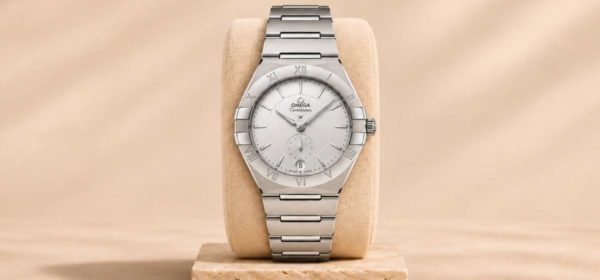
Choose the Constellation if…
You appreciate recognizable design, distinctive case details, and bracelet-focused styling.
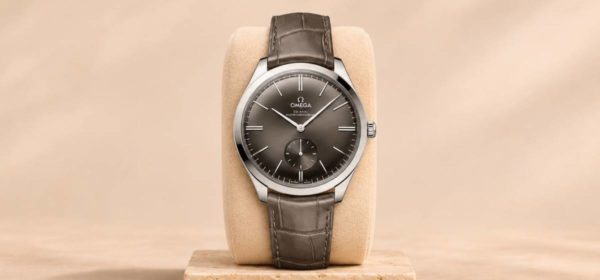
Choose the De Ville if…
You prefer traditional round cases, understated elegance, and a classic dress-watch appearance. The best choice depends on what you enjoy wearing, not simply which collection is more prestigious.
- A Constellation may be your preference if you want a watch that feels like a piece of jewellery as well as a timepiece. Its recognizable design can become a defining element of your personal style.
- A De Ville may be the better match if you appreciate simplicity, classic proportions, and a more traditional watchmaking aesthetic. With options ranging from Prestige to Trésor, there is considerable variety to explore.
Before deciding, compare the following:
- Design: Which watch would you enjoy looking at every day?
- Fit: Does the case sit comfortably on your wrist and beneath your cuffs?
- Movement: Do you prefer quartz convenience or mechanical watchmaking?
- Styling: Does the dial, metal, and strap complement your wardrobe?
- Budget: Are you comparing equivalent specifications rather than collection names alone?
Exploring different Omega watches can help you understand how the designs vary across references. And if you are deciding between specific models, you can visit Berani in Toronto to inquire about available options and compare the details that matter most to you.
Frequently Asked Questions
1. Is the Omega Globemaster part of the Constellation family?
Yes. The Globemaster belongs to the Constellation family but features a more traditional design, including its distinctive pie-pan dial.
2. Are De Ville Prestige and De Ville Trésor the same?
No. Both belong to the De Ville family but differ in design, proportions, and movement options.
3. Can vintage Constellation watches be compared with modern De Ville models?
Yes, but vintage models require additional checks for originality, restoration, condition, and service history.
4. Which is better for everyday wear, Constellation or De Ville?
Both can be suitable for daily wear. The best choice depends on the model’s comfort, movement, water resistance, and strap.
5. Is Omega Constellation more expensive than De Ville?
Not necessarily. Prices vary depending on the model, materials, movement, size, and decorative details.