
Cartier Watch Ownership Guide: Materials, Movements, Care and Everyday Wear
Buying a Cartier watch is only the beginning. What happens after purchase depends heavily on what you actually own.
A stainless-steel Santos worn most days will age differently from a gold Tank on leather. A quartz Panthère asks much less of its owner mechanically than an automatic Cartier, yet its bracelet, case, and seals still need attention over time.
That is why a useful Cartier watch ownership guide should not rely on one universal set of rules. Material, movement, strap or bracelet, water-resistance rating, age, and frequency of wear all affect what ownership looks like.
The goal is not to keep a Cartier looking untouched forever. It is to recognize which alterations are typical, which behaviors contribute to the watch’s preservation, and which symptoms call for expert care.
What Cartier Watch Ownership Actually Involves
Most changes that appear during regular use are not automatically problems.
Fine scratches on polished metal, small creases in a leather strap, and an automatic watch stopping after several days off the wrist can all be normal parts of ownership. A quartz watch will eventually need battery attention as well.
What deserves more attention is a sudden change.
Moisture beneath the crystal, unusual resistance when winding, a noticeably shorter power reserve, a loose crown, unexpected noises, or a major shift in mechanical accuracy should not be dismissed as ordinary wear.
Before following generic advice, identify the exact model and movement. Cartier’s collections vary considerably, and the care routine that suits one watch may not suit another.
If you are still deciding which Cartier is right for you rather than already owning one, Berani’s Cartier watch buying guide covers that earlier stage of the process.
Living With Different Cartier Materials
Browse Cartier watches in different materials.
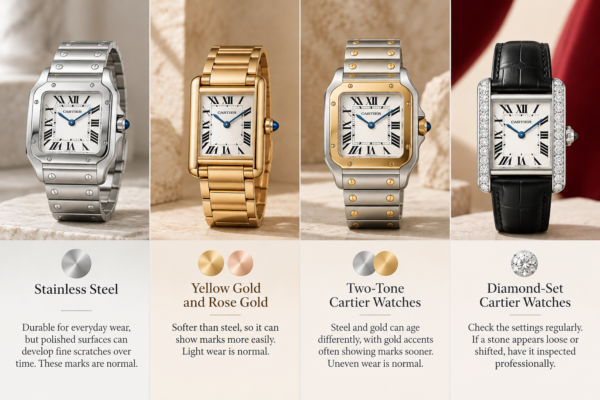
Stainless Steel
Steel works well for frequent wear, but polished surfaces can develop fine scratches over time. These marks are normal, and frequent polishing is best avoided because it can gradually soften case edges and finishes.
Yellow Gold and Rose Gold
Gold is softer than steel, so it can show marks more easily. Light wear is normal, while refinishing should be handled conservatively to preserve the watch’s original shape and finish.
Two-Tone Cartier Watches
Steel and gold can age differently, with gold accents often showing marks sooner. Uneven wear is normal and reflects the different materials rather than a defect.
Diamond-Set Cartier Watches
Diamond-set models require attention to the settings as well as the case. If a stone appears loose or shifted, have the watch inspected professionally and avoid home tightening or aggressive cleaning.
Bracelet vs. Leather Strap Ownership
Once the watch is worn frequently, the distinction between the bracelet and strap becomes much more apparent.
Metal Bracelets
A Cartier bracelet should fit securely without feeling unnecessarily tight.
Over time, owners may notice dirt accumulating between links, normal clasp wear, or gradual changes in articulation. These areas are worth checking periodically because bracelet condition affects both comfort and how the watch sits on the wrist.
Avoid household chemicals or abrasive brushing, particularly on bracelets combining polished and brushed surfaces.
Leather Straps
Leather should be viewed differently.
Cartier states that its leather straps have an average lifespan of around 24 months under normal conditions, although water, perspiration and other liquids can shorten that considerably. Pasted markdown
Typical ageing includes:
- Creasing around frequently used holes
- Darkening from wear
- Edge wear
- Changes in texture or structure
- Odour after repeated exposure to perspiration
The strap’s usable life can be increased by keeping it free from cosmetics, excessive wetness, and prolonged humidity.
Quartz Cartier Ownership
Quartz ownership is straightforward, but not maintenance-free.
A quartz Cartier does not need to be wound, making it particularly convenient for owners who rotate between several watches or want to pick up the watch and wear it immediately.
Eventually, however, the battery will require replacement.
If a quartz watch stops, a depleted battery may be the simple explanation. Even so, it is preferable to avoid leaving a dead battery inside the watch for an extended period of time. Professional battery replacement also provides an opportunity to inspect the seals and general condition.
If you want a broader explanation of quartz, automatic, and hand-wound mechanisms, Berani’s guide to different watch movement types explains how their ownership requirements differ.
Automatic Cartier Ownership
Automatic watches behave differently because they rely on movement of the wrist to maintain their power reserve.
If an automatic Cartier sits unused long enough, it can stop completely. That alone does not indicate a fault.
Starting or manually winding the watch should follow the instructions for its particular calibre rather than a universal winding routine.
More meaningful warning signs include a sudden change in accuracy, an unusually short power reserve, or a winding action that begins to feel rough or inconsistent.
Mechanical watches also should not be judged against quartz precision. Some variation is inherent to mechanical timekeeping.
Manual-Wind Cartier Ownership
A manual-wind Cartier makes winding part of the ownership experience.
Rather than being powered by wrist movement, it must be wound by hand at appropriate intervals.
The important habit is to wind gently and pay attention to how the crown feels. If it becomes unusually resistant, rough, or appears to slip, forcing it is not advisable.
There is no useful universal rule for the number of crown turns because calibres differ. The correct routine should come from the instructions for the particular movement.
How Much Water Exposure is Safe?
This is one area where owners should avoid assumptions.
Cartier watches do not all share the same water-resistance rating, and even the original rating does not remain a permanent guarantee. Seals age, watches are opened for servicing or battery changes, and pre-owned pieces may have an unknown history.
Check the exact model before swimming, showering, or deliberately exposing it to water.
Extra caution is appropriate with vintage watches and older pre-owned examples. Their original specifications do not confirm their current sealing condition.
If moisture or condensation appears beneath the crystal, arrange professional assessment promptly.
Everyday Scratches: What is Normal?
Scratches are one of the first things new owners tend to notice.
Polished Cartier cases can reveal fine marks surprisingly quickly under bright light. Bracelets also tend to develop hairlines around high-contact areas.
That is different from:
- Deep dents
- Damaged case edges
- Excessive bracelet wear
- Bent components
- Major clasp damage
Trying to remove every minor mark can create a bigger long-term issue than simply accepting normal wear. Cartier cases often depend on defined edges and contrasting finishes, which repeated refinishing can gradually alter.
A good Cartier watch ownership guide therefore includes knowing when not to intervene.
Magnetism and Mechanical Cartier Watches
Strong magnetic fields can affect some mechanical movements.
There is no need to treat ordinary electronics as a constant threat, but it is sensible not to leave a mechanical Cartier directly against strong magnets, powerful magnetic clasps, or speakers for extended periods.
If the watch suddenly begins running unusually fast or behaves differently after known magnetic exposure, testing may be worthwhile.
This concern is primarily relevant to mechanical movements rather than quartz ownership.
How to Store a Cartier Watch
Storage does not need to be complicated.
- Use a soft-lined box or watch case: Keep the watch in its own compartment so it does not rub against jewellery, keys, or other watches.
- Keep it dry and cool: Avoid prolonged direct sunlight, high humidity, and excessive heat.
- Let leather straps dry first: After perspiration or warm weather, allow the strap to air-dry naturally before putting it away.
- Do not assume an automatic watch needs a winder: It is normal for an automatic Cartier to stop when unworn. In many cases, it can simply be reset and wound before the next wear.
- Keep it away from strong magnets: Avoid storing a mechanical Cartier next to magnetic clasps, speakers, or other strong magnetic sources.
- Store documents separately: Keep purchase receipts, warranty information, and service records somewhere safe for future servicing, insurance, or resale.
When Does a Cartier Watch Need Professional Attention?
There is no single service timetable that works for every Cartier.
Age, movement, condition, use, and the individual model all matter, which is why Berani’s more detailed guide to Cartier watch maintenance is more useful than applying one fixed interval to every watch.
Professional assessment becomes particularly worthwhile when you notice:
- Significant changes in mechanical accuracy
- Noticeably reduced power reserve
- Moisture beneath the crystal
- Abnormal winding resistance
- A damaged crown or clasp
- A leather strap beginning to fail structurally
- Unusual sounds
- A stopped quartz watch
- Bracelet components that feel excessively loose
Battery replacement, movement servicing, water-resistance testing, refinishing, and structural bracelet repairs are also better handled professionally.
For a pre-owned watch, condition and service history become even more important because previous polishing, water exposure, or bracelet wear may not be obvious at first glance. Berani’s guide to pre-owned luxury watches in Canada explains what to review when assessing an older piece.
How Ownership Differs Across Popular Cartier Collections
One reason a Cartier watch ownership guide cannot rely on one routine is that the collections themselves are very different.
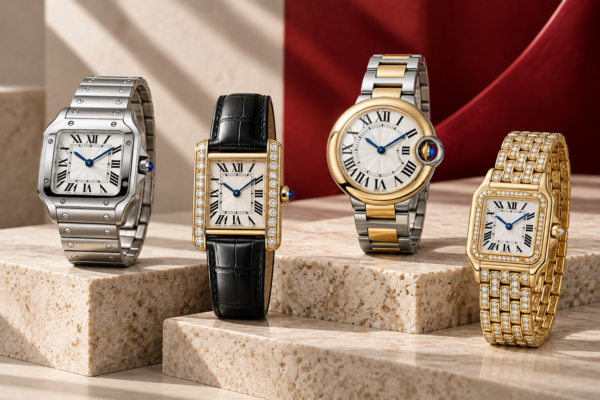
Panthère de Cartier
The Panthère is strongly defined by its flexible bracelet, so fit, articulation, and cleanliness between links matter.
Many Panthère references use quartz movements, which keep mechanical ownership simple, while gold and diamond-set versions place more emphasis on protecting surface finishes and settings.
Santos de Cartier
The Santos presents different considerations.
Its visible screws and mix of polished and brushed areas make everyday marks easy to notice, while selected modern models offer interchangeable bracelet and strap systems.
Owners of aSantos de Cartier should follow the correct instructions for their bracelet system and movement rather than treating all Santos references alike.
Cartier Tank
Tank ownership varies enormously.
The family includes quartz, SolarBeat and mechanical references, while straps range from traditional leather to metal bracelets such as those used on the Tank Française.
Leather requires moisture awareness. Bracelet models require more attention to links and clasp wear. Highly polished rectangular cases can also show hairlines clearly.
Ballon Bleu de Cartier
The rounded profile of the Ballon Bleu creates another ownership experience.
Its curved case and prominent crown area deserve protection from impacts, while bracelet and leather versions age differently.
Movement choice also varies across references, so habits should always be based on the actual watch.
A Simple Cartier Ownership Routine
Good ownership is mostly about consistency rather than constant intervention.
After wearing the watch, wipe it gently with a clean, soft cloth when appropriate. Periodically check the crown, bracelet, clasp, or strap for changes. Allow leather to dry before storage, arrange battery attention when a quartz watch needs it, and pay attention to unusual changes in a mechanical movement’s accuracy or power reserve.
Most importantly, know the specifications of your own watch.
That approach is more useful than trying to make one set of rules fit every Cartier.
Owners who want to compare how materials, movements, and bracelet styles differ across the current range can also explore Berani’s selection of Cartier watches.
Frequently Asked Questions
1. Is It Normal for a Cartier Watch to Get Scratched?
Yes. Fine surface marks are normal with regular wear, particularly on polished steel and gold. Deep dents, damaged edges, and major bracelet wear are different and may justify professional inspection.
2. Should I Keep My Automatic Cartier on a Watch Winder?
Not necessarily. An automatic Cartier can simply be restarted after it stops. Whether a winder is useful depends on the movement and how frequently you wear the watch.
3. How Long Does a Cartier Leather Strap Last?
Cartier gives an average lifespan of approximately 24 months under normal use, although perspiration, moisture, and frequency of wear can shorten it. Pasted markdown
4. Can I Wear My Cartier Watch in the Shower?
Do not assume that you can. Check the water-resistance rating and current condition of your specific watch. Seals age, so the original specification does not necessarily represent the watch’s present resistance.
5. Should I Polish My Cartier Every Time It Gets Scratched?
No. Light marks are part of normal ownership. Repeated refinishing can gradually alter case edges and surface finishes, so polishing should generally be conservative and professionally handled.