
Quartz vs. Automatic Cartier Watches: Which Movement Should You Choose?
Choosing between a quartz and automatic Cartier is less about deciding which movement is “better” and more about deciding how you want to live with the watch.
A quartz Cartier is usually the easier choice if you value accuracy, slim proportions, and minimal daily involvement. An automatic Cartier offers a more traditional mechanical experience, with a movement powered through wrist motion and occasional manual winding.
Cartier uses both deliberately across important collections, so don’t view quartz as a lesser option. The right choice depends on the exact model, how often you will wear it, and how much interaction you want with the movement. This Cartier quartz vs. automatic comparison explains how the two movement types differ in accuracy, ownership, servicing, design, and everyday use.
Cartier Quartz vs. Automatic: Quick Comparison
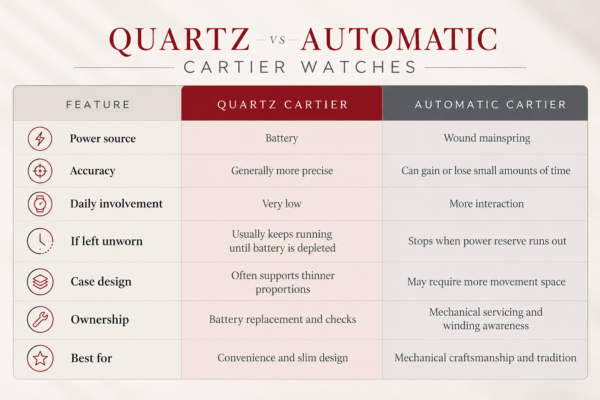
How a Quartz Cartier Watch Works
A quartz Cartier watch uses a battery to send an electrical current through a quartz crystal. The crystal oscillates at a highly stable frequency, allowing the movement to regulate time very consistently.
Unlike a mechanical watch, it does not need to be wound.
Cartier also offers more than one type of quartz technology. In 2018, the Maison introduced a high-efficiency quartz movement designed for approximately eight years of autonomy in relevant watches.
SolarBeat is different again. It is a photovoltaic quartz movement that converts light into energy rather than relying only on a conventional battery. Current Tank Must SolarBeat watches are examples of this technology.
For a broader explanation of the mechanics, Berani’s guide to different watch movement types compares quartz, automatic, and manual-wind systems in more detail.
How an Automatic Cartier Watch Works
An automatic Cartier is mechanical.
Inside the movement, a mainspring stores energy. A rotor moves as the wearer moves their wrist, helping wind the spring and keep the watch running.
If the watch sits unworn long enough, the power reserve will eventually run out, and the watch will stop. That is normal.
Many current Santos de Cartier references use Cartier’s 1847 MC automatic calibre, including steel medium and large models.
Automatic watches can usually also be wound manually, but the exact procedure should follow the instructions for the specific calibre.
Which is More Accurate?
For everyday timekeeping, quartz is usually more accurate.
A quartz crystal is electronically regulated, so there is less day-to-day variation than in a mechanical movement. Automatic watches can run slightly fast or slow depending on wear, position, and operating conditions.
That does not make an automatic Cartier poor at timekeeping. Its appeal lies in mechanical engineering, traditional watchmaking, and the experience of wearing a movement made up of many interacting components.
If accuracy is one of your main priorities, quartz has the advantage.
Convenience: Where Quartz Really Wins
Quartz works particularly well for owners who want to put on the watch and go.
There is no need to think about winding or power reserve, and a quartz Cartier is especially convenient if you rotate between several watches or wear one only occasionally.
Automatic ownership requires a little more involvement. If the watch has stopped, you may need to wind it, reset the time, and possibly reset the date before wearing it.
For someone who enjoys that interaction, it can be part of the appeal rather than an inconvenience.
Battery Life vs. Power Reserve
These two terms are often confused.
- Battery life on a quartz Cartier is measured in years. Cartier currently states that quartz battery life averages at least three years in its general care guidance, although its high-efficiency quartz movement is designed for much longer autonomy.
- Power reserve on an automatic watch is measured in hours or days. Once that stored energy is used, the watch stops until it is wound again.
Power reserve varies by calibre, so there is no useful single number for every automatic Cartier. For example, the current large Santos with the 1847 MC lists a 40-hour power reserve.
Does Movement Type Affect the Look of a Cartier?
Yes, sometimes significantly.
Quartz movements can support very slim cases, which suits collections where elegance and jewellery-like proportions are central to the design.
That is one reason quartz appears frequently in compact Tank and Panthère models.
Automatic movements need room for a gear train, rotor, and other mechanical components. This can influence case thickness, but the difference is not universal. A well-designed automatic Cartier can still wear relatively slim.
When comparing Cartier quartz vs. automatic models, it is more useful to compare exact references than to assume every quartz watch will be thinner than every automatic one.
Which Cartier Collections Use Quartz?
Panthère de Cartier
Quartz is common throughout the Panthère collection and suits its jewellery-first character particularly well.
Its flexible bracelet and compact cases are often more important to the wearing experience than mechanical complexity, which makes quartz a natural fit.
Cartier Tank
The Tank family uses several movement types.
Many Tank Must models use conventional or high-efficiency quartz, while others use SolarBeat or mechanical movements.
That variety is one reason it is useful to understand what the Cartier Tank watch is before assuming every Tank behaves the same way.
Santos
The wider Santos family also includes multiple movement types, depending on the model and generation. Quartz, automatic, manual-wind, and skeleton watches can all appear within the broader family.
Always check the exact reference rather than assuming based on the collection name.
Which Cartier Collections Use Automatic Movements?
Santos de Cartier
The Santos is one of Cartier’s strongest automatic offerings.
Many current references use the 1847 MC automatic calibre, including medium and large steel models.
If you are specifically drawn to the collection, Berani’s guide to theSantos de Cartier gives more context on its design and evolution.
Ballon Bleu de Cartier
Selected Ballon Bleu references use automatic movements, particularly in larger sizes.
Because the collection also includes other movement types, the exact model still matters.
Cartier Tank
Automatic Tank references also exist, depending on sub-collection and size.
This is a good example of why movement type should be confirmed individually rather than assigned to an entire Cartier family.
Quartz Cartier: Main Advantages and Trade-Offs
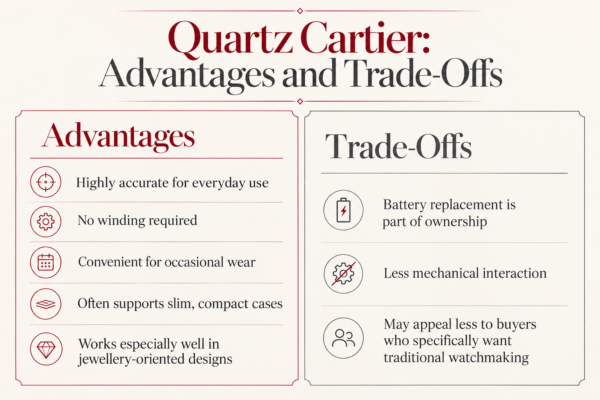
It is also worth avoiding the assumption that quartz automatically means poor resale. Model, condition, rarity, and demand all influence value. Berani’s guide to Cartier watches and resale value covers that topic in more detail.
Automatic Cartier: Main Advantages and Trade-Offs
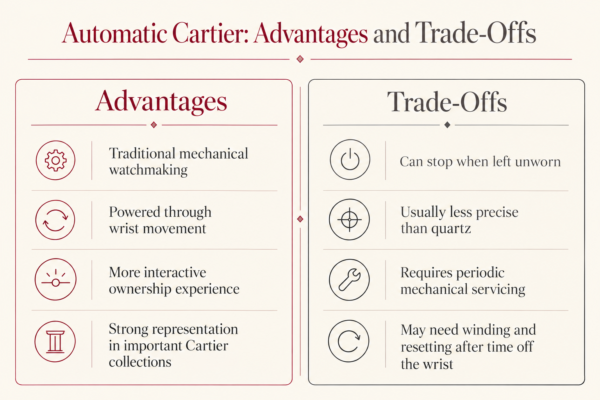
Servicing and Long-Term Ownership
Quartz watches still need proper care.
Battery replacement should be handled professionally, and Cartier advises against leaving an exhausted battery in the watch because it may damage the movement. Water resistance and seals should also be checked when appropriate.
Automatic watches need mechanical attention because they rely on lubricated moving parts.
Cartier currently recommends a functional check every six years, with earlier inspection if a watch begins running noticeably fast or slow. That should not be confused with saying every watch requires a complete overhaul on a rigid six-year schedule.
For more detail on battery care, water resistance, and servicing, see Berani’s Cartier watch maintenance guide.
Which Is Better for Everyday Wear?
Quartz is usually better for someone who wants:
- Maximum convenience
- Strong everyday accuracy
- Little interaction with the movement
- A watch that can sit unworn for long periods and remain ready to wear
Automatic may be better for someone who wants:
- Mechanical watchmaking to be part of the experience
- A watch worn regularly
- More interaction with winding and power reserve
- The appeal of a traditional mechanical calibre
The movement should not be the only deciding factor. Case size, bracelet or strap, water resistance, and overall comfort matter just as much.
Which Is Better for a First Cartier?
There is no universal winner in the Cartier quartz vs. automatic debate.
- Choose quartz if Cartier’s design is what matters most to you and you want straightforward ownership.
- Choose automatic if you specifically want mechanical watchmaking to be part of the purchase.
In many cases, the better first Cartier is simply the reference you like most on the wrist.
What to Check Before Choosing
Before buying, confirm:
- Whether the movement is standard quartz, high-efficiency quartz, SolarBeat, or automatic
- Case size and thickness
- Battery-life or power-reserve expectations
- Current water-resistance rating
- Service history on a pre-owned watch
- Whether a previous quartz battery replacement or mechanical service has been documented
Berani’s selection of Cartier watches is a useful place to compare different movement types, sizes, and collections side by side.
Frequently Asked Questions
1. Are Quartz Cartier Watches Real Luxury Watches?
Yes. Cartier deliberately uses quartz movements across important collections, especially where slim proportions, convenience, and jewellery-like design are priorities.
2. Is an Automatic Cartier More Accurate Than a Quartz Cartier?
Generally, no. Quartz is usually more accurate. Automatic watches are valued more for mechanical craftsmanship and traditional watchmaking.
3. Does a Quartz Cartier Need Servicing?
Yes. Battery replacement, seals, water resistance, and the movement itself still require attention over time.
4. What Happens If I Do Not Wear an Automatic Cartier?
Once the power reserve is exhausted, the watch stops. That is normal and does not automatically mean something is wrong.
5. Does Cartier Make Both Quartz and Automatic Santos Watches?
Yes. The broader Santos family includes different movement types depending on the model, including quartz, automatic, manual-wind, and skeleton references.