
Cartier Panthère vs. Ballon Bleu: Which Watch Fits Your Style?
Choosing between the Cartier Panthère and Ballon Bleu is largely a question of how you want a Cartier watch to look and feel on your wrist.
Both are unmistakably Cartier, with Roman numerals, blue details, and elegant proportions appearing across the collections. But their personalities are very different. The Panthère is built around its fluid bracelet and has the character of fine jewellery that also tells the time. The Ballon Bleu is rounder, fuller, and more sculptural, giving the watch case itself a much stronger presence.
The difference becomes even clearer once you compare their sizes, movements, bracelets, metals, and diamond configurations. Exact specifications vary by reference and production period, so the most useful Cartier Panthère vs. Ballon Bleu comparison is one that considers the individual watches you are deciding between.
Cartier Panthère vs. Ballon Bleu at a Glance
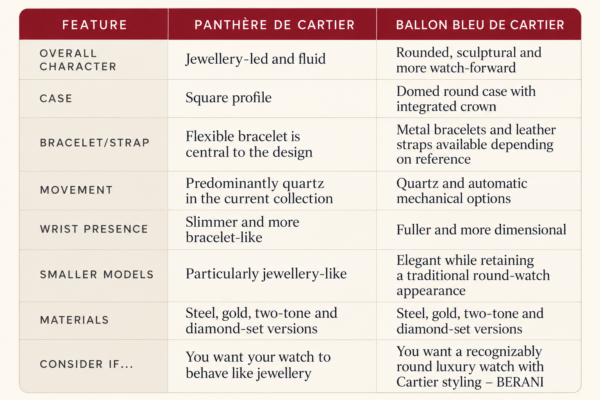
How the Cartier Panthère and Ballon Bleu Designs Differ
The biggest Cartier Panthère vs. Ballon Bleu difference can be understood before looking at specifications: one design starts with the bracelet, while the other starts with the shape of the case.
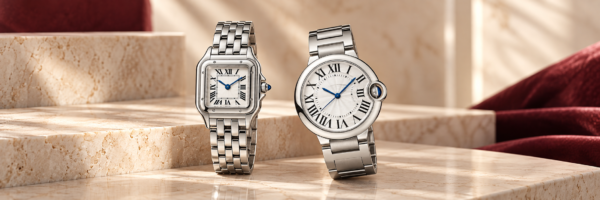
Panthère de Cartier: Jewellery First
The bracelet is arguably the defining element of the Panthère de Cartier watch.
Cartier says the Panthère was designed in the 1980s and takes its name from its ultra-flexible bracelet, whose movement evokes the Maison’s emblematic panther. Cartier itself describes the Panthère as both a watch and a piece of jewellery.
Its square case, Roman numerals, blue crown detail, and sword-shaped hands are recognizably Cartier, but the case does not visually dominate the watch. Instead, the articulated bracelet continues the design around the wrist.
That makes the Panthère especially appealing if you normally wear bangles or other fine jewellery. A smaller Panthère can blend naturally into a jewellery stack, while a larger or full-gold version can make the bracelet itself the statement.
This jewellery-first character is also useful to consider when comparing different gold Cartier watches for women.
For a closer look at sizing, metals, bracelet feel, and different configurations, see our complete Cartier Panthère watch guide.
Ballon Bleu de Cartier: Round and Sculptural
The Ballon Bleu approaches Cartier design very differently.
Introduced in 2007, the Ballon Bleu was created around what Cartier describes as a new vision of roundness. Its case is domed at both the front and back, while the winding crown is incorporated into the side of the case rather than simply projecting from it.
The blue crown detail is particularly recognizable, but its exact material depends on the reference. Cartier currently uses a sapphire cabochon on some Ballon Bleu models and a synthetic blue spinel on others.
That rounded construction gives the Ballon Bleu considerably more visual volume than the flatter Panthère. Berani similarly describes the collection as a strong option for buyers who prefer rounded softness and a more noticeable wrist presence.
In a Cartier Panthère vs. Ballon Bleu comparison, therefore, do not look only at millimetres. The Panthère spreads its visual impact across its case and bracelet, while the Ballon Bleu concentrates more attention on its rounded case.
Cartier Panthère vs. Ballon Bleu Sizes
Size labels alone do not tell you which watch will look larger.
The Panthère uses a square- or rectangular-inspired case, while the Ballon Bleu is round. Thickness, bracelet width, metal, and diamonds can also change the visual effect considerably.
Panthère Sizes
The Panthère is available across compact and larger proportions. Mini and small versions lean especially strongly into the collection’s jewellery character, while medium and large models give the dial more prominence.
For example, Cartier’s current large yellow-gold Panthère measures 42 x 31 mm but remains only 6.71 mm thick.
That slimness is important. A Panthère can occupy substantial space across the wrist without feeling like a conventional large round watch.
Ballon Bleu Sizes
The Ballon Bleu has been produced in a broad range of sizes and configurations. Berani’s current selection includes examples ranging from a compact 28 mm quartz steel model to 33, 36, and 42 mm automatic references.
Cartier’s current 28 mm steel model, for example, uses a quartz movement and measures 9.35 mm thick. A current 33 mm steel Ballon Bleu uses a self-winding mechanical movement and is approximately 10 mm thick.
The smaller Ballon Bleu references retain the collection’s soft, elegant character, while larger sizes make the domed round case much more prominent.
When comparing Cartier Panthère vs. Ballon Bleu sizes, try adjacent sizes rather than assuming that your preferred Panthère dimensions translate directly to the Ballon Bleu.
Bracelet and Strap Differences
This is another area where the Cartier Panthère vs. Ballon Bleu distinction becomes obvious.
The Panthère’s highly flexible multi-link bracelet is fundamental to the watch. It is not simply a way to attach the case to your wrist; visually and physically, it is part of the identity of the watch.
The Ballon Bleu offers more variation. Depending on the reference, Cartier produces models with metal bracelets or leather straps, and many contemporary references use interchangeable systems. A metal bracelet reinforces the rounded case and gives the watch greater visual presence, while leather can create a lighter and more traditional dress-watch appearance.
If the bracelet itself is one of the main reasons you are buying the watch, the Panthère deserves particular attention. If you prefer the option of a more conventional case-and-strap relationship, the Ballon Bleu offers greater variation across references.
Cartier Panthère vs. Ballon Bleu: Quartz or Automatic?
Movement is one of the most practical differences between these collections.
The contemporary Panthère collection is strongly associated with quartz movements. Cartier’s current steel, gold, and two-tone Panthère models include numerous quartz references, allowing the case to remain exceptionally slim.
The Ballon Bleu offers a broader choice between quartz and mechanical movements.
For example, the 28 mm steel Ballon Bleu is quartz, while current 33 mm steel and gold references are available with self-winding mechanical movements. Larger Ballon Bleu references also include automatic options.
Neither should automatically be treated as the “better” movement. Quartz offers convenient, accurate timekeeping with relatively simple day-to-day ownership. An automatic movement may appeal more if the mechanics of traditional watchmaking are part of what attracts you to the purchase.
Our guide to different watch movement types explains the differences in more detail.
Most importantly, confirm the movement of the exact reference you are considering. Movement type should never be assumed from the collection name or case size alone.
Steel, Gold, Two-Tone, and Diamonds
Metal changes the personality of both watches, but it does so in different ways.
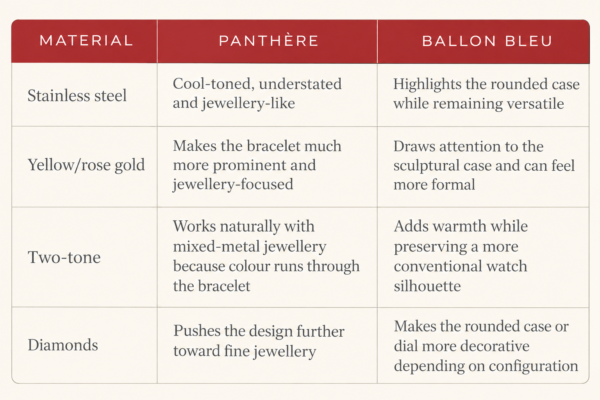
Both collections include many variations within these categories. A few diamond hour markers, for example, create a very different effect from a diamond-set bezel or an extensively gem-set case and bracelet.
Material, movement, size, and gem setting can also significantly influenceCartier watch prices, so compare like-for-like configurations rather than collection names alone.
Gold also requires a little more consideration for everyday use. It is softer than stainless steel and can show surface marks more readily. Steel can scratch as well, particularly on polished surfaces, so neither material should be treated as maintenance-free.
Which Cartier Watch Fits Your Style?
The most useful way to settle the Cartier Panthère vs. Ballon Bleu question is to decide what role you want the watch to play.
- Consider the Panthère if you want a watch that behaves almost like a piece of fine jewellery, prefer a slim profile, consider the bracelet a major part of the design, or regularly coordinate your watch with other bracelets.
- Consider the Ballon Bleu if you prefer a round case, want the watch itself to have more volume on the wrist, appreciate the integrated blue crown detail, or want to explore a broader mix of quartz, automatic, bracelet, and leather-strap references.
For everyday ownership, both collections can work well. Steel versions can be particularly versatile, while gold and diamond-set models require more consideration around scratches and contact with other jewellery. Movement also matters: quartz and automatic watches have different maintenance requirements, which are explained further in our guide toCartier watch maintenance.
Ultimately, Cartier Panthère vs. Ballon Bleu is less about which collection is universally more versatile and more about whether you want your Cartier to sit closer to fine jewellery or traditional watchmaking.
What to Check Before Buying a Panthère or Ballon Bleu
Before purchasing either collection, compare the exact references rather than relying on names such as “small,” “medium,” or “large.”
Check the reference number, exact case dimensions and thickness, movement, case material, diamond configuration, bracelet or strap, and overall condition. With a pre-owned watch, also inspect the dial, crystal, crown, clasp, bracelet links, case finishing, and available service history.
Boxes, warranty cards, and receipts can provide useful provenance, but they should not be treated as proof of authenticity on their own. Our guide toCartier watch authenticity covers additional details to examine when assessing a Cartier.
Most importantly, try the watches on when possible. A photograph or diameter measurement cannot fully show how the Panthère’s flexible bracelet or the Ballon Bleu’s domed case will sit on your particular wrist.
Berani offers authentic Cartier watches that can be compared in person, making it easier to judge proportions, bracelet feel, metal colour, and overall wrist presence before choosing.
Frequently Asked Questions
1. Does the Panthère Look Smaller Than the Ballon Bleu?
Often, but not necessarily. The Panthère’s slim case and fluid bracelet can make it appear more delicate, while the Ballon Bleu’s domed round case creates greater visual volume. The exact result depends on the references being compared.
2. Does the Ballon Bleu de Cartier Come in Quartz?
Yes. Ballon Bleu has been produced with both quartz and mechanical movements. Cartier currently offers a 28 mm steel Ballon Bleu with a quartz movement, while numerous 33 mm and larger references use automatic mechanical movements.
3. Can You Stack a Ballon Bleu With Bracelets?
Yes, although the visual effect differs from the Panthère. The Panthère naturally behaves like part of a jewellery stack because of its flexible integrated bracelet. The Ballon Bleu has a more pronounced case, so pay attention to spacing and avoid allowing harder jewellery to rub continuously against the watch.
4. Is a Gold Panthère More Delicate Than a Steel Ballon Bleu?
Gold is softer than stainless steel and generally shows scratches and surface marks more readily. However, the condition depends on how a particular watch is worn, stored, and maintained rather than simply whether it belongs to the Panthère or Ballon Bleu collection.
5. Which Has More Wrist Presence: Cartier Panthère or Ballon Bleu?
At comparable proportions, the Ballon Bleu generally looks more like a conventional watch because its domed round case is the main visual element. The Panthère distributes more of its visual presence through its bracelet. Metal, diamonds, and the specific size can substantially change that impression, so an in-person comparison remains the most reliable way to choose.